

If you work as a caregiver in Walnut Creek, California, you may spend long days helping an older adult remain safely in their home.
Your work might include helping someone get dressed in the morning, preparing meals, assisting with bathing, driving to medical appointments, managing medications, doing laundry, or staying overnight in case help is needed.
For many caregivers, the workday does not end after eight hours.
You may work 10 hours.
12 hours.
Overnight.
Or even 24-hour shifts.
But your paycheck may look exactly the same no matter how long you work.
That raises an important question:
Are private caregivers in Walnut Creek entitled to overtime pay?
In many situations, yes.
California provides overtime protections for many caregivers and domestic workers who provide care inside private homes. The exact overtime rules depend on your duties, whether you qualify as a “personal attendant,” whether you live in the client's home, how many hours you work, and other details of your employment relationship.
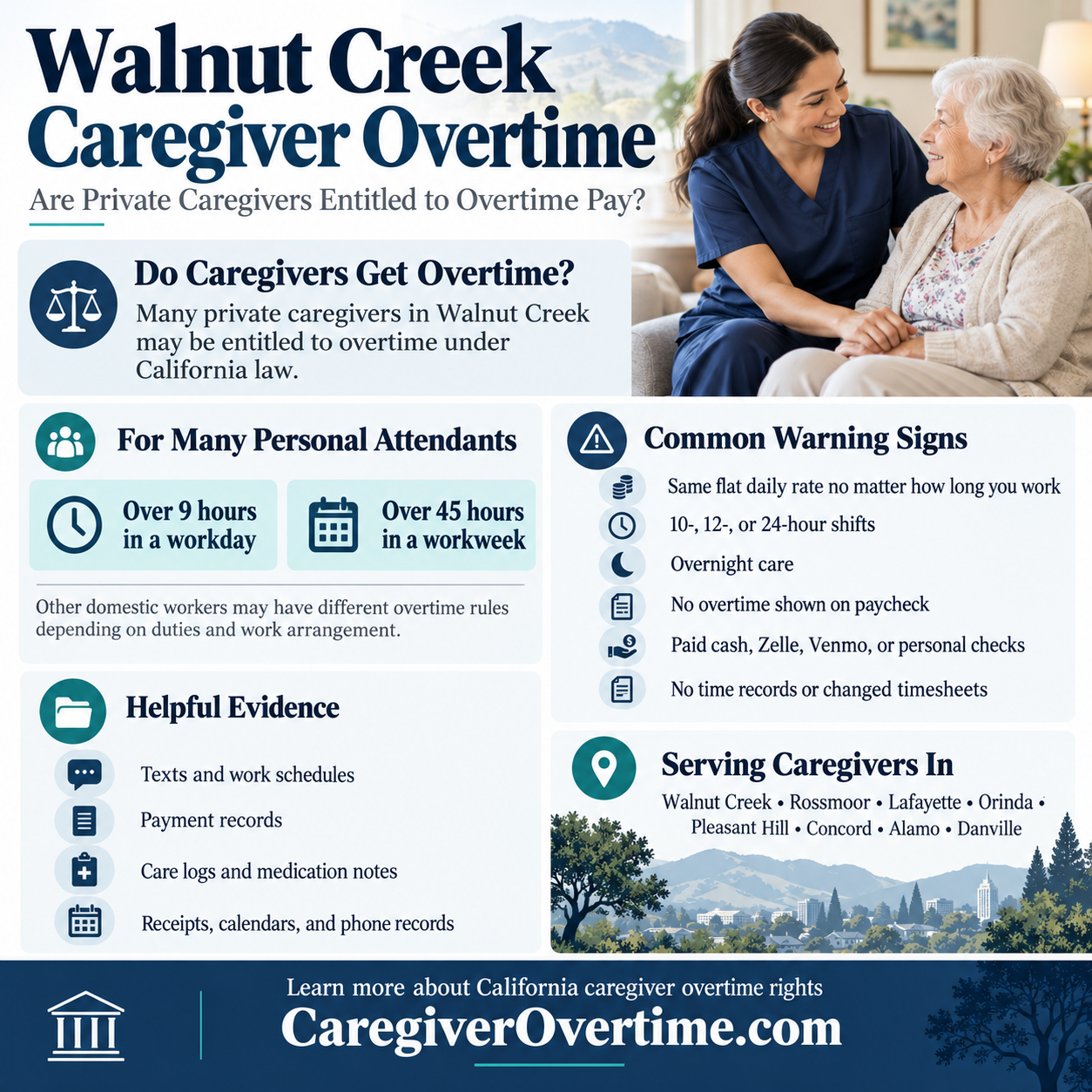
For many personal attendants working in private households, California overtime generally applies after nine hours in a workday or 45 hours in a workweek.
Other domestic workers may qualify for overtime under different—and sometimes more protective—rules.
If you provide private home care in Walnut Creek, Rossmoor, Lafayette, Orinda, Pleasant Hill, Concord, Alamo, Danville, or elsewhere in Contra Costa County, it may be worth understanding how these rules apply to your schedule.
Do Caregivers Get Overtime in Walnut Creek, California?
Many do.
Walnut Creek does not have a separate caregiver overtime system. Caregivers working in Walnut Creek are generally protected by applicable California wage-and-hour laws, including California's Domestic Worker Bill of Rights and Wage Order 15.
Under California law, covered personal attendants working in private households are generally entitled to overtime at 1.5 times their regular rate of pay when they work:
More than 9 hours in a workday, or
More than 45 hours in a workweek
The California Labor Commissioner's Office specifically identifies caregivers and personal attendants as domestic workers covered by these protections in appropriate circumstances.
However, not every caregiver is classified the same way.
Your actual job duties can change which overtime rules apply.
Why Caregiver Overtime Is Particularly Relevant in Walnut Creek
Walnut Creek has a large older population.
According to U.S. Census Bureau estimates, approximately 29.5% of Walnut Creek residents are age 65 or older.
That is an unusually high percentage for a California city of roughly 70,000 people.
The broader Walnut Creek area is also home to major retirement and senior communities, including Rossmoor, along with affluent surrounding communities such as Lafayette, Orinda, Alamo, Danville, and parts of the Lamorinda and San Ramon Valley areas.
As more older adults choose to remain at home rather than move into institutional care, families may hire caregivers directly to provide:
Personal care
Companionship
Mobility assistance
Medication reminders
Meal preparation
Transportation
Overnight supervision
Dementia care
Household assistance
These arrangements can become very informal.
A family may simply tell a caregiver:
“We'll pay you $250 per day.”
or:
“You can stay overnight and we'll pay $300.”
But informal employment arrangements are not automatically exempt from California wage law.
What Is a “Personal Attendant” Under California Law?
This distinction is important.
Under California's domestic-worker rules, a personal attendant generally provides care to someone who needs assistance because of advanced age, disability, or another condition.
Personal-attendant duties commonly include:
Feeding
Bathing
Dressing
Direct supervision
Assisting the person receiving care
California also distinguishes those duties from substantial household-maintenance work.
That may include:
Housecleaning
Laundry
Cooking
Making beds
Other household maintenance
If a caregiver spends more than a certain portion of their working time performing non-attendant duties, they may not qualify as a personal attendant for overtime purposes.
That can be important because a domestic worker who is not classified as a personal attendant may be entitled to different overtime protections.
If your job in Walnut Creek involves substantial household work in addition to personal care, see our guide:
When Does Overtime Begin for a Walnut Creek Personal Attendant?
For many covered personal attendants working in private homes, California overtime begins after:
9 hours worked in one day
or:
45 hours worked in one workweek
For example, imagine a Walnut Creek caregiver works:
Monday: 12 hours
Tuesday: 12 hours
Wednesday: 12 hours
Thursday: 12 hours
Friday: 12 hours
That is 60 hours in one workweek.
Simply paying the caregiver the same flat amount for every day does not automatically establish that overtime has been properly paid.
The caregiver's classification, regular rate of pay, number of compensable hours, and compensation structure need to be examined.
For more detail, read:
How Many Hours Can a Caregiver Work in California Before Overtime Is Owed?
What If I Am Not a “Personal Attendant”?
Other domestic workers may have different overtime rights.
For example, a non-live-in domestic worker who is not classified as a personal attendant may generally be entitled to overtime after:
8 hours in a workday, or
40 hours in a workweek
and potentially double time in certain circumstances.
Different rules can apply to live-in domestic workers.
This is one reason a caregiver's actual duties matter so much.
Your employer cannot necessarily determine your legal classification simply by calling you:
“Caregiver”
“Companion”
“Private aide”
“Home helper”
or:
“Independent contractor.”
The work you actually perform matters.
Can a Walnut Creek Family Pay a Caregiver a Flat Daily Rate?
Families frequently pay private caregivers a fixed daily amount.
For example:
“$225 per day.”
“$300 for a 24-hour shift.”
“$1,500 per week.”
A flat daily or weekly rate is not necessarily illegal by itself.
But a flat payment does not automatically eliminate overtime obligations.
If you work substantially different numbers of hours while receiving exactly the same pay, it may be worth examining how the employer calculated your wages.
For example:
8 hours → $250
12 hours → $250
16 hours → $250
If your employer says:
“Your overtime is included.”
ask:
How was the overtime actually calculated?
We explain this issue in detail here:
My Caregiver Employer Says My Flat Daily Rate Includes Overtime — Is That Legal in California?
Do Overnight Caregivers in Walnut Creek Have to Be Paid?
Potentially.
Overnight caregiver pay is one of the most commonly misunderstood areas of home-care employment.
An employer may tell you:
“You were sleeping, so we don't have to pay you.”
But nighttime caregiving arrangements can be more complicated.
Questions may include:
Were you required to remain in the client's home?
Could you leave during the night?
Were you responsible for responding when the client woke up?
Did you assist with bathroom trips?
Did you reposition the client?
Did you give medications?
Did you respond to alarms or emergencies?
How frequently was your sleep interrupted?
Were you genuinely relieved of all caregiving responsibility?
The answers can affect whether some or all nighttime hours count as compensable working time.
Caregivers working long overnight schedules should read:
24-Hour Shifts Explained: What Caregivers Must Be Paid for Overnight Work in California
and:
What Is the Difference Between Being On Call and Off Duty as a Caregiver?
What If I Work in Rossmoor?
Caregivers working in Rossmoor and the greater Walnut Creek area may encounter exactly these kinds of private-home employment arrangements.
An older adult may need help for 10, 12, or more hours each day.
A caregiver may be hired directly by:
The client
The client's son
The client's daughter
A spouse
A trustee
Another family member
The caregiver may work for the same household for months or years.
Being hired directly by a family rather than a traditional company does not automatically eliminate California wage-and-hour protections.
Depending on the circumstances, one or more individuals involved in hiring, scheduling, supervising, or paying the caregiver may potentially qualify as an employer.
For more information, read:
Can Family Members Be Required to Pay Caregiver Overtime in California?
What If My Employer Pays Me Cash, Zelle, Venmo, or Personal Checks?
That is common in private caregiving.
A Walnut Creek caregiver might receive:
Cash
Zelle
Venmo
Cash App
Personal checks
Bank transfers
without ever receiving a traditional payroll check.
The method used to pay you does not necessarily determine whether California wage laws apply.
A caregiver who is legally an employee may still have wage-and-hour rights even if the employment arrangement was informal.
Payment records may also become useful evidence.
For example, weekly Zelle payments can help establish:
That an employment relationship existed
How frequently you were paid
How much you received
How long the arrangement continued
Read:
California Caregivers Paid Cash or “Off the Books”: Do You Still Have the Right to Overtime Pay?
What If My Walnut Creek Employer Never Kept Track of My Hours?
Do not automatically assume you have no wage claim.
California places important timekeeping and payroll-record responsibilities on employers.
Private caregivers often work without formal time clocks.
You might have been told:
“Just come at 7 every morning.”
Maybe everyone knew your regular schedule, but nobody created a formal timesheet.
Later, if a wage dispute arises, the employer may say:
“There are no records proving you worked those hours.”
But you may have more evidence than you realize.
Potential evidence can include:
Text messages
Calendars
Work schedules
Zelle or Venmo records
Bank deposits
Care logs
Medication logs
Doctor appointments
Grocery receipts
Pharmacy receipts
Phone records
Photos
Location history
Witnesses familiar with your schedule
For a detailed explanation, see:
My Caregiver Employer Says There Are No Records of My Hours — Can I Still Bring a Wage Claim?
What If My Employer Changed My Timesheet?
Suppose you actually worked:
7:00 a.m. to 7:00 p.m.
But your payroll records show:
8:00 a.m. to 5:00 p.m.
Or your employer:
Added meal periods you never took
Removed nighttime hours
Changed your arrival time
Changed your departure time
Deleted overtime
Told you to record fewer hours than you actually worked
That deserves closer examination.
Employers may correct genuine timekeeping mistakes, but removing hours that were actually worked presents a very different issue.
Read:
My Employer Changed My Timesheet: What California Caregivers Should Know
What If My Employer Calls Me a 1099 Independent Contractor?
A private family may tell a Walnut Creek caregiver:
“You're an independent contractor.”
They may even issue a Form 1099.
But a label does not necessarily determine your legal status.
Questions can include:
Who determines your schedule?
Who controls when you arrive and leave?
Who tells you what duties to perform?
Do you operate an independent caregiving business?
Do you work continuously for one household?
Can you freely send another worker in your place?
Who determines your pay?
A caregiver who is legally an employee may potentially be entitled to protections that the employer assumed did not apply.
See:
Am I an Independent Contractor or an Employee? Understanding Your Rights as a California Caregiver
Can I Recover Unpaid Overtime After Quitting My Walnut Creek Caregiver Job?
Potentially, yes.
Quitting does not automatically erase wages you already earned.
Many caregivers do not question their pay until after leaving the job.
Once they stop working, they finally look back at the schedule:
12-hour days.
Five or six days per week.
Overnight shifts.
Flat daily pay.
No overtime listed.
That is often when they begin wondering whether they were paid correctly.
Former caregivers can learn more here:
Can a California Caregiver Recover Unpaid Wages After Quitting?
Deadlines apply, so caregivers should not assume they can wait indefinitely before investigating possible unpaid wages.
What If I Was Fired From My Caregiving Job?
If your employer ended the employment relationship, additional final-pay issues may arise.
California generally requires discharged employees to receive earned and unpaid wages when they are terminated.
If your final paycheck omitted overtime, missing hours, or other wages, there may be additional questions about whether you were paid everything due.
Read:
I Was Fired as a Caregiver — When Does My Employer Have to Pay My Final Wages?
How Can I Tell Whether I May Be Owed Caregiver Overtime?
Start by asking yourself these questions:
Do you regularly work more than nine hours per day?
If you qualify as a covered personal attendant, those additional hours may potentially trigger daily overtime.
Do you work more than 45 hours per week?
For many covered personal attendants, weekly overtime may apply after 45 hours.
Are you paid the same amount regardless of your hours?
A flat rate does not automatically prove overtime was properly paid.
Do you stay overnight?
Determine whether you are genuinely relieved from work or remain responsible for the client.
Do you perform substantial cleaning or household work?
That may affect whether you are classified as a personal attendant.
Does your pay stub show overtime?
If you regularly work long shifts but never see overtime reflected, it may be worth reviewing the calculation.
Does your employer keep accurate time records?
If not, begin preserving your own evidence.
How Should a Walnut Creek Caregiver Document Their Hours?
If you currently work as a caregiver, start keeping your own record.
For each shift, write down:
Date
Start time
End time
Meal periods
Overnight interruptions
Additional duties
Whether you were permitted to leave
Total hours worked
Also save:
Text messages
Work schedules
Payment records
Care instructions
Calendars
Emails
For overnight caregivers, record each interruption.
For example:
10:30 p.m. — helped client into bed
1:15 a.m. — bathroom assistance
3:40 a.m. — repositioned client
5:25 a.m. — medication
Those details may become important later.
See:
How to Document Your Hours as a Live-In or Overnight Caregiver in California
Frequently Asked Questions About Walnut Creek Caregiver Overtime
Do private caregivers in Walnut Creek get overtime?
Many private caregivers do. Covered California personal attendants are generally entitled to 1.5 times their regular rate for hours worked over nine in a day or 45 in a week. Other domestic workers can be subject to different overtime rules.
Is caregiver overtime different in Walnut Creek than elsewhere in California?
Walnut Creek caregivers are generally governed by applicable California wage-and-hour laws. The city does not create a separate caregiver overtime exemption.
Can a Walnut Creek caregiver be paid a flat daily rate?
A caregiver may be paid a flat daily amount, but the arrangement still must satisfy applicable minimum-wage and overtime requirements. Calling a payment a “daily rate” does not automatically eliminate overtime.
Are 12-hour caregiver shifts entitled to overtime?
Potentially. For many covered personal attendants, hours worked beyond nine in a workday are overtime hours.
Are 24-hour caregiver shifts legal in Walnut Creek?
Long caregiver shifts can occur, but determining how many hours are compensable can require examining sleep periods, off-duty time, interruptions, and how much control the employer had over the caregiver.
Do overnight caregiver hours count?
They may. Whether overnight time is compensable depends on the circumstances, including whether the caregiver was free from duties and whether sleep was interrupted.
Can I recover overtime if I was paid cash?
Potentially. Cash payment does not automatically eliminate employment or overtime rights.
What if I have no timesheets?
That does not necessarily prevent a claim. Texts, calendars, payments, care logs, receipts, phone records, and other evidence may help reconstruct your hours.
What if I already quit?
Quitting does not automatically eliminate wages that were already earned, although deadlines for pursuing claims apply.
What if the family says caregivers don't get overtime?
That statement is too broad. California specifically provides overtime protections to many personal attendants and domestic workers.
Warning Signs That Your Caregiver Pay May Need a Closer Look
Consider reviewing your pay if you work in Walnut Creek or the surrounding area and:
Work 10-, 12-, 16-, or 24-hour shifts
Receive the same flat amount every day
Never see overtime on your paycheck
Are paid cash without wage statements
Work overnight but are automatically unpaid for sleep
Regularly work more than 45 hours per week
Perform substantial cooking, cleaning, or laundry
Are labeled a 1099 independent contractor
Have no formal time records
Had your recorded hours reduced
Were told that “caregivers don't get overtime”
Were told that your daily rate “includes everything”
None of these facts automatically proves that wages are owed.
But they may be reasons to examine your employment arrangement more carefully.
Walnut Creek Caregivers May Have More Overtime Rights Than They Realize
Walnut Creek's large older population means private caregivers play an important role helping seniors remain safely in their homes.
But caregiving work can also involve unusually long schedules.
A caregiver may spend 10, 12, or even 24 hours responsible for another person while receiving the same flat daily payment.
California law does not simply assume that arrangement is correct because the caregiver agreed to it.
The real questions are:
What work did you perform?
How many hours did you actually work?
Were you a personal attendant or another type of domestic worker?
How was your regular rate calculated?
Was legally required overtime actually paid?
If you work—or previously worked—as a private caregiver in Walnut Creek, Rossmoor, Lafayette, Orinda, Pleasant Hill, Concord, Alamo, Danville, or elsewhere in Contra Costa County and believe you may have been underpaid, consider speaking with an attorney familiar with California caregiver wage-and-hour law.
Think you may be owed unpaid caregiver overtime? Contact Caregiver Overtime to discuss your situation and learn what options may be available.
This article provides general information about California wage-and-hour law and is not legal advice. Caregiver overtime rights depend on the worker's actual duties, schedule, employment relationship, live-in status, applicable wage order, and other facts.