

Can a California Caregiver Recover Unpaid Wages After Quitting?
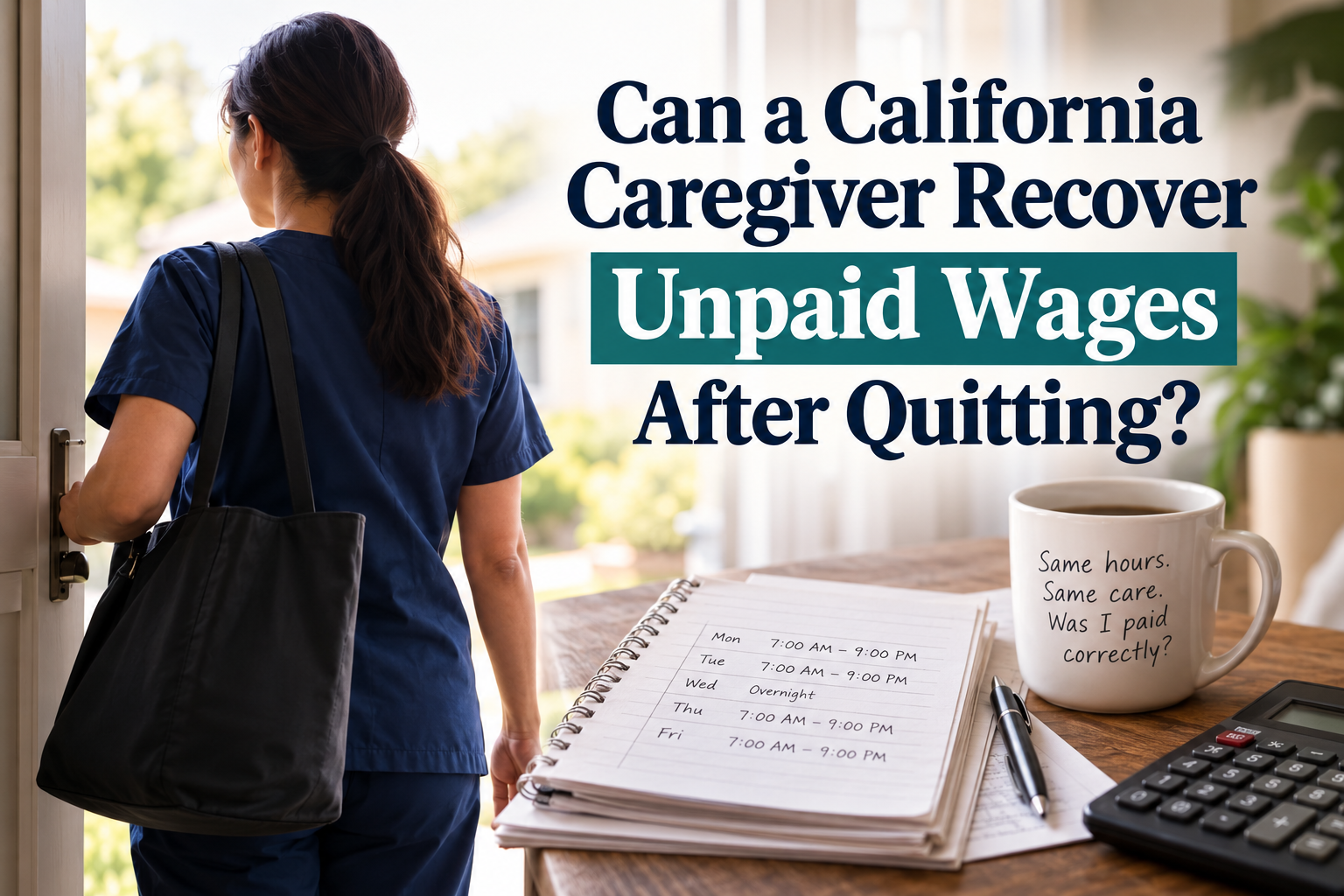
You quit your caregiving job.
Maybe you were exhausted from working long shifts. Maybe your schedule became impossible. Maybe the relationship with the family became uncomfortable. Or perhaps you simply found another job.
Then, after leaving, you started looking more closely at your pay.
You realize you may not have been paid for all of your hours.
Maybe you regularly worked overtime but received the same flat daily rate. You stayed overnight with your client. You answered calls or helped during supposed “off” hours. Your employer changed your timesheets. Or you were paid cash without detailed records showing how your wages were calculated.
Now you may be wondering:
Did I lose the right to recover unpaid wages because I quit?
In many situations, the answer is no.
Leaving a caregiving job does not automatically erase wages you already earned. California workers may still be able to pursue unpaid wages after their employment has ended, subject to applicable deadlines and the specific facts of the case.
For caregivers who worked long hours, overnight shifts, or unusual schedules, leaving the job may actually be the first opportunity they have had to step back and ask:
Was I really paid correctly?
Quitting Does Not Automatically Erase Wages You Already Earned
If you were legally entitled to wages for work you already performed, quitting generally does not make those wages disappear.
Depending on the circumstances, a former caregiver could potentially have claims involving:
Unpaid regular wages
Unpaid overtime
Unpaid minimum wages
Hours that were never recorded
Certain meal or rest period violations
Unlawful deductions
Unpaid business-expense reimbursements
Final-paycheck violations
Other compensation required under California law
The important question usually is not simply whether you quit.
The more important questions are:
What work did you perform? How many hours did you work? How were you paid? And how was your employment classified?
If you are unsure whether you were being underpaid before you left, our article on how to tell if you're being underpaid as a caregiver in California explains some of the most common warning signs.
“But I Quit Voluntarily. Doesn't That Mean I Gave Up My Claim?”
No.
A caregiver does not ordinarily surrender already-earned wages simply because he or she voluntarily ends the employment relationship.
Consider a caregiver who worked for a private household for two years.
She was paid $250 per day and regularly worked from 7:00 a.m. until 9:00 p.m. She was told the daily payment covered everything, regardless of the number of hours worked.
Eventually, she quit.
Quitting does not, by itself, determine whether she was properly paid during those two years.
Her duties, schedule, compensation arrangement, employment status, applicable wage rules, and actual hours worked would still need to be examined.
An employer may say things like:
“You agreed to the rate.”
“You knew what you were getting paid.”
“You never complained.”
“You quit.”
“The daily rate included everything.”
Those statements do not necessarily establish that all legally required wages were paid.
What About Caregivers Who Were Paid a Flat Daily or Weekly Rate?
This can be an especially important issue for caregivers.
Some private caregivers are told:
“We pay $200 per day.”
or:
“Your salary is $1,500 per week no matter how many hours you work.”
A flat rate does not automatically eliminate overtime obligations.
California caregiver overtime rules can depend on the caregiver's duties, schedule, employment relationship, and whether particular exemptions apply.
For many domestic caregivers, overtime rules may apply when they work more than nine hours in a workday or more than 45 hours in a workweek.
You can read more about these thresholds in our guide to how many hours a caregiver can work in California before overtime is owed.
For caregivers routinely working very long days, simply multiplying a flat daily rate by the number of days worked may not determine whether the caregiver received everything required by law.
That becomes especially important with live-in, overnight, 12-hour, or 24-hour caregiving arrangements.
What If I Worked Overnight or 24-Hour Shifts Before I Quit?
Overnight work is one of the areas where caregiver wage disputes frequently arise.
An employer may tell a caregiver:
“You were sleeping, so those hours don't count.”
“The client was asleep.”
“You weren't actively working.”
“Your daily rate included overnight time.”
But the analysis can be more complicated.
If you were required to remain in the client's home, remain available to assist, respond to nighttime interruptions, or otherwise could not use the time freely, some or all of that time may potentially be compensable.
Our article on 24-hour caregiver shifts and overnight pay in California explains this issue in greater detail.
Another important distinction is whether you were actually off duty or merely on call.
If your employer told you that you were off the clock but you still had to remain available to help the client, read our guide explaining the difference between being on call and off duty as a California caregiver.
That difference can substantially affect the number of hours for which you may have been entitled to pay.
I Quit Because I Wasn't Being Paid Correctly. Can I Still Make a Claim?
Potentially, yes.
You do not necessarily have to raise a wage complaint while you are still employed in order to later investigate unpaid wages.
Many caregivers never question their pay while they are working.
They may depend heavily on the job.
They may have developed a close relationship with the client.
They may be uncomfortable challenging the client's children or other family members.
They may have been told that the pay arrangement is normal in private caregiving.
Others simply do not realize there may be a problem until later.
After leaving, they compare their schedule with their payments and suddenly realize:
“I was working 70 or 80 hours every week. Was I actually being paid correctly?”
Leaving the job does not necessarily prevent you from asking that question.
What Happens to Your Final Paycheck When You Quit?
California has specific rules governing final wages when an employee resigns.
Generally, an employee who gives at least 72 hours' advance notice of quitting must be paid all wages due at the time of quitting.
If the employee quits without giving at least 72 hours' notice, final wages generally must be paid within 72 hours after quitting.
The precise rules can depend on the circumstances.
This matters because your final paycheck should not necessarily include only the hours your employer happened to record.
If additional wages were legally due, such as unpaid compensation for hours previously worked, there may still be a dispute over whether your final wages were actually paid in full.
Could a Former Caregiver Receive a Waiting Time Penalty?
Potentially.
California law provides for what is commonly called a waiting time penalty when an employer willfully fails to pay wages due after an employee quits or is discharged, assuming the legal requirements for the penalty are satisfied.
The penalty may continue for each day the wages remain unpaid, up to 30 days.
That does not mean every late or disputed final paycheck automatically creates a 30-day penalty.
For example, whether there is a legitimate good-faith dispute concerning the wages can matter.
But final-pay issues are worth examining when a former caregiver believes wages were still outstanding when the employment relationship ended.
What If My Employer Changed My Timesheets Before I Quit?
This deserves special attention.
Suppose you worked from 7:00 a.m. until 7:00 p.m., but your paycheck reflects only nine hours.
Or perhaps your employer:
Added meal breaks you did not actually take
Removed nighttime hours
Changed your start or end time
Reduced hours after you submitted them
Told you to record fewer hours than you actually worked
Those changes can significantly affect unpaid-wage and overtime calculations.
An employer may correct a genuine error, but simply deleting hours that were actually worked presents a very different issue.
If this happened to you, read My Employer Changed My Timesheet: What California Caregivers Should Know.
How Long Do I Have to Bring an Unpaid-Wage Claim?
This is one of the most important reasons not to wait.
Different types of California wage claims can have different deadlines.
Depending on the particular claim, the applicable period may be one, two, three, four, or another number of years.
That means a former caregiver should not assume:
“I quit, so it's too late.”
But they also should not assume:
“I can deal with this whenever I want.”
The amount that can potentially be recovered may depend partly on when the violations occurred and when a claim is pursued.
The safest approach is to determine the applicable deadline based on the specific facts rather than waiting until records are lost or time runs out.
What If I Quit Months Ago?
Do not automatically assume that it is too late.
Depending on when the work occurred and what type of claim may exist, unpaid wages from months or even years earlier might still fall within an applicable limitations period.
For example, suppose you left a caregiver position eight months ago.
Only recently, you learned that some of the long shifts you worked may have required overtime compensation.
The fact that you left eight months ago does not, by itself, determine whether those wages can still be pursued.
The dates matter, however.
So does the type of claim.
What If I Don't Have My Timesheets?
This is one of the biggest concerns former caregivers have.
You may think:
“I don't have records, so I can't prove anything.”
That is not necessarily true.
Even if you did not keep perfect timecards, other evidence may help show when and how much you worked.
Potential evidence could include:
Text messages with the client or family
Work schedules
Calendars
Emails
Paychecks
Bank deposits
Venmo or Zelle payments
Pay stubs
Care logs
Medication logs
Medical appointment schedules
Grocery or pharmacy receipts
Photographs
Phone records
Location history
Messages showing when you arrived or left
Statements from others familiar with your schedule
If you are still working as a caregiver—or still have access to your records—our guide on how to document your hours as a live-in or overnight caregiver explains what information can be useful to preserve.
Even after quitting, it can be helpful to reconstruct your typical schedule while the details are still fresh in your memory.
What If I Was Paid Cash, Zelle, Venmo, or “Off the Books”?
The method of payment does not automatically determine whether wage protections apply.
Many caregivers are paid:
Cash
Personal checks
Zelle
Venmo
PayPal
Direct transfers
Some receive no pay stubs at all.
Being paid informally does not necessarily mean the caregiver has no wage rights.
If this sounds like your situation, see our article explaining whether California caregivers paid cash or “off the books” can still have overtime rights.
Payment records can also become important evidence after employment ends because they may help establish how frequently you were paid and how much you received.
What If My Employer Called Me an Independent Contractor?
Being called an independent contractor does not automatically make you one.
Employment status depends on the actual relationship between the worker and the hiring party, not simply the title printed on a document or tax form.
If you:
Worked a schedule determined by the family or agency
Provided ongoing caregiving services
Were directed regarding the client's care
Did not operate an independent caregiving business
Were simply told that you were a “1099 worker”
it may be worth examining whether the classification was correct.
Our article Am I an Independent Contractor or an Employee? Understanding Your Rights as a California Caregiver explains some of the factors that may matter.
Misclassification can be particularly important because an improperly classified caregiver may not have received overtime or other protections that could have applied if the worker had been treated as an employee.
What If a Family Member Hired and Paid Me?
Many caregivers do not work for traditional companies.
Instead, they may be hired directly by:
The client's son
The client's daughter
A spouse
A trustee
Another family member
This sometimes leads caregivers to believe wage laws do not apply because they were working for a private household instead of a company.
That assumption may be incorrect.
Depending on the circumstances, a private individual or family member may have employer responsibilities.
For more information, read Can Family Members Be Required to Pay Caregiver Overtime in California?.
This can become especially important after a caregiver quits because the worker may need to determine who was actually responsible for employing and paying them.
What If I Never Complained About My Pay While I Was Working?
Many caregivers do not.
That does not necessarily mean the wages were correct.
Caregiving relationships can be unusual because the workplace is someone's home and the employer may be the client or a member of the client's family.
Over time, the relationship may feel personal rather than professional.
A caregiver may think:
“I didn't want to upset the family.”
“I loved my client.”
“I needed the job.”
“They told me everyone gets paid this way.”
“I assumed my salary included everything.”
“I didn't know caregivers could receive overtime.”
Those circumstances are not unusual.
The central question is generally whether the caregiver received the compensation legally required for the work that was performed.
What Should You Do After Leaving a Caregiving Job?
If you suspect you were underpaid, start preserving information now.
Save copies of:
Text messages
Work schedules
Calendars
Pay records
Bank statements showing payments
Electronic payment records
Emails
Care notes
Employment agreements
Timesheets
Photographs or other information that may establish your working hours
It may also be useful to write down your typical schedule while you still remember it.
For example:
Monday: 7:00 a.m.–9:00 p.m.
Tuesday: 7:00 a.m.–9:00 p.m.
Wednesday: Overnight shift
Thursday: Off
Friday: 8:00 a.m.–8:00 p.m.
If you worked overnight, also try to document:
Whether you could leave the home
Whether you were required to stay
How often the client woke you
What tasks you performed overnight
Whether hours were automatically removed as “sleep time”
Whether you had any period when you were completely relieved of responsibility
Those details may become important in determining the number of compensable hours you actually worked.
You May Have More Rights After Quitting Than You Think
Leaving a caregiving job does not necessarily close the door on unpaid wages.
If you worked long days, overnight shifts, or 24-hour shifts—or if you were paid a flat daily or weekly rate—it may be worth reviewing how you were compensated.
The same is true if your employer:
Changed your recorded hours
Failed to give you pay stubs
Paid you off the books
Called you an independent contractor
Excluded overnight or on-call hours
Failed to include all wages in your final paycheck
You already performed the work.
Quitting does not automatically erase the right to wages you may have legally earned.
But deadlines apply, and caregiver wage disputes can involve complicated questions about job duties, employment status, overtime, live-in arrangements, sleep periods, on-call time, and the identity of the actual employer.
If you believe you were not properly paid while working as a caregiver in California, consider speaking with an attorney familiar with California caregiver wage-and-hour law about your particular situation.
This article provides general information about California wage-and-hour law and is not legal advice. The application of wage-and-hour laws depends on the specific facts of each employment relationship.