

What Is the Difference Between Being "On Call" and "Off Duty" as a Caregiver? California Law Explained
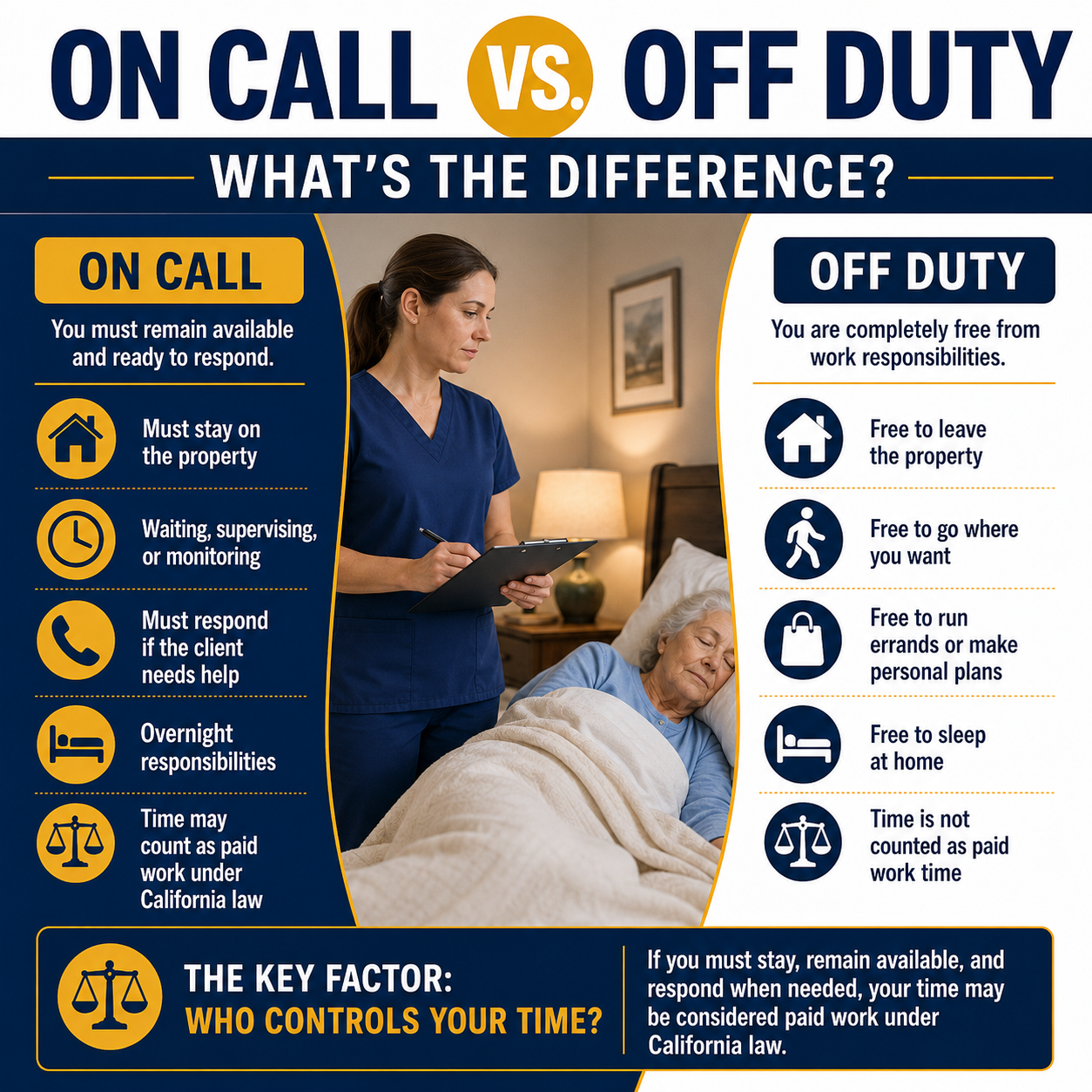
One of the most misunderstood aspects of California caregiver wage law is the difference between being on call and being off duty.
Many caregivers hear statements like:
"You're not working right now."
"The client is sleeping."
"You can relax until you're needed."
"We'll only pay you when you're actively helping."
At first glance, these statements may sound reasonable.
After all, if you're sitting quietly in the home while your client watches television or takes a nap, it may not feel like you're working.
But under California law, the question is often not whether you're actively performing a task.
Instead, one of the most important questions is:
Who controls your time?
That distinction can have a major impact on whether your time counts as compensable work and whether you may be entitled to overtime.
Why This Difference Matters
Many caregiver wage claims involve long periods where the caregiver is:
Waiting
Supervising
Remaining available
Staying overnight
Monitoring a client
If these hours count as work, they increase:
Total hours worked
Overtime calculations
Potential unpaid wages
For caregivers working 12-, 16-, or 24-hour shifts, this distinction can represent hundreds or even thousands of hours over the course of a year.
What Does "On Call" Mean?
Being on call generally means you must be ready to respond if your client needs assistance.
Examples include:
Staying in the home while a client naps
Remaining awake during overnight shifts
Waiting for medication times
Supervising someone with dementia
Being available if a fall occurs
Remaining nearby during hospice care
Although you may not be actively performing physical tasks every minute, your responsibilities have not ended.
What Does "Off Duty" Mean?
Being off duty generally means you have been completely relieved of your work responsibilities.
For example:
You finish your shift at 6:00 PM.
You leave the home.
You are free to:
Go wherever you want
Visit friends
Run errands
Sleep at home
Turn off your phone
During this time, your employer no longer controls your activities.
This is much different from remaining inside the client's home waiting to help.
California Often Looks at Employer Control
One of the key considerations under California wage law is whether the caregiver remains under the employer's control.
Ask yourself:
Could you leave the home?
Could you take another job during that time?
Could you ignore the client if they needed help?
Could you go shopping?
Could you watch a movie elsewhere?
If the answer is no, your time may still be considered work time depending on the specific circumstances.
Common On-Call Situations
Waiting While a Client Sleeps
Many caregivers stay beside a sleeping client.
Although the client is asleep, the caregiver must:
Stay in the home
Listen for movement
Help with bathroom trips
Prevent falls
Respond to emergencies
This responsibility may affect whether that time qualifies as compensable work.
Waiting During the Day
A client watches television.
The caregiver:
Cannot leave
Must supervise
Must respond immediately if needed
Although little physical work is happening, the caregiver remains responsible for the client's safety.
Medication Monitoring
Some caregivers spend hours waiting until the next medication schedule.
Even during those quiet periods, they remain responsible for:
Monitoring symptoms
Watching for side effects
Being immediately available
Again, employer control becomes an important consideration.
Examples of True Off-Duty Time
Off-duty periods generally involve genuine freedom.
Examples include:
Leaving the property
Taking a personal lunch without responsibilities
Ending your shift
Having no obligation to answer calls
Being free to use your time however you choose
The key difference is that the caregiver is no longer responsible for the client.
Why Live-In Caregivers Face Unique Challenges
Live-in caregivers often experience the greatest confusion.
Because they live inside the home, they may:
Supervise throughout the day
Sleep in the home
Respond overnight
Remain available around the clock
Many employers assume only active caregiving counts as work.
In reality, determining compensable time often requires a careful evaluation of the caregiver's responsibilities and the amount of control the employer exercised during those periods.
Flat Daily Rates Often Ignore On-Call Time
Many caregivers receive:
$250 per day
Weekly salaries
Cash payments
Flat overnight rates
These arrangements frequently fail to account for:
Waiting time
Overnight supervision
On-call responsibilities
Overtime
As a result, caregivers may unknowingly lose substantial wages.
Common Misunderstandings
"You Were Just Sitting There."
Watching television with a client may still involve constant supervision and availability.
"You Were Sleeping."
If your sleep was interrupted or you remained responsible for responding to the client's needs, portions of that time may still qualify as compensable work depending on the circumstances.
"You Weren't Busy."
California wage law does not simply ask whether you were busy.
It often asks whether your employer continued to control your time.
What Evidence Can Help?
If your employer disputes your schedule, documentation can be valuable.
Helpful records include:
Daily journals
Text messages
Care logs
Medication schedules
Overnight notes
Calendars
Shift schedules
These records may help demonstrate the extent of your responsibilities during waiting periods.
Frequently Asked Questions
Is waiting for a client to need help considered work?
It may be. Whether waiting time is compensable often depends on the level of employer control and your responsibilities during that time.
Does supervising a sleeping client count?
It can. If you are required to remain available and respond to the client's needs, that supervision may be an important factor in determining compensable time.
What if I couldn't leave the home?
If you were required to stay on the property and remain available, that restriction may be relevant when evaluating whether the time counts as hours worked.
Does on-call time affect overtime?
Yes. If on-call time qualifies as compensable work, it increases the total hours worked, which may affect overtime calculations.
Final Takeaway
For California caregivers, the difference between being on call and off duty can significantly affect whether certain hours count as paid work.
Simply because a shift becomes quiet does not necessarily mean you are off the clock.
If you remained responsible for a client's safety, were required to stay on-site, or had to respond whenever needed, your employer may have continued to exercise control over your time.
Understanding this distinction is important because it may affect not only your regular wages, but also overtime, waiting time, and the total value of a potential wage claim.
If you've spent long hours supervising clients, staying overnight, or remaining available without additional compensation, it may be worthwhile to review whether your time was properly counted under California law.