

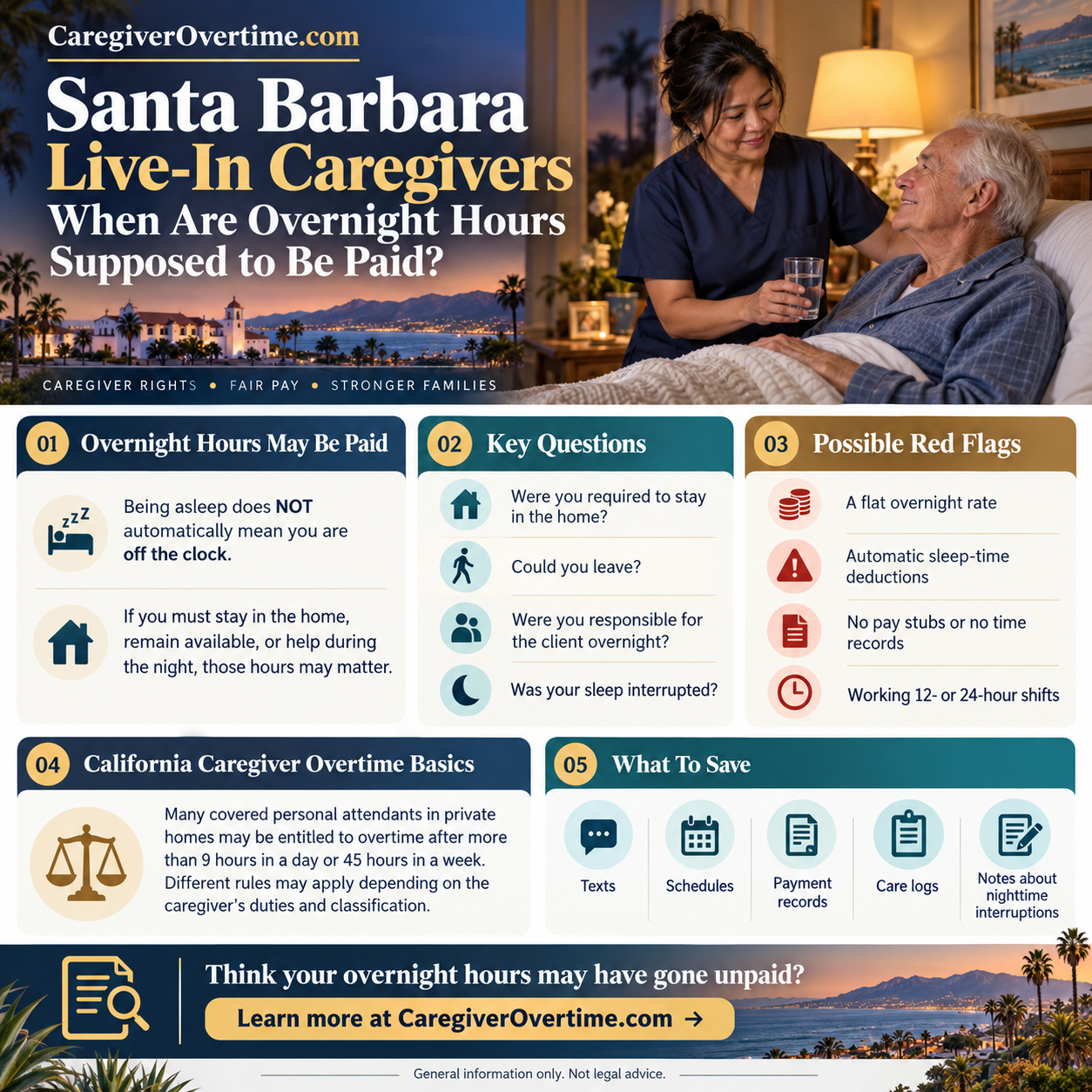
If you work as a live-in or overnight caregiver in Santa Barbara, California, some of the hardest questions about your pay may happen after the client goes to bed.
Your employer may tell you:
“You’re sleeping, so those hours don’t count.”
Or:
“We pay one flat rate for the entire overnight shift.”
Or:
“You’re off duty unless the client wakes up.”
But what if you are required to remain in the home?
What if you have to listen for the client?
What if you wake up several times each night to help with toileting, medication, repositioning, falls, dementia-related wandering, or other care?
That raises an important question:
When are overnight hours supposed to be paid for a Santa Barbara caregiver?
The answer depends on the specific employment arrangement.
California law treats caregiver overtime, live-in work, personal-attendant status, and off-duty time differently depending on the worker’s actual duties and circumstances.
But one principle is especially important:
An employer cannot necessarily treat nighttime hours as unpaid simply because the client is sleeping.
Do Santa Barbara Caregivers Get Paid for Overnight Hours?
They may.
Whether nighttime hours count as compensable work can depend on factors such as:
Whether you must remain at the client’s home
Whether you are free to leave
Whether you remain responsible for the client
Whether your sleep is interrupted
How often you provide care overnight
Whether you have genuine off-duty periods
Whether you qualify as a personal attendant
Whether you actually live in the client’s home
California defines “hours worked” for household occupations as time when an employee is subject to the employer’s control, as well as time the employee is suffered or permitted to work.
That means the real question is often not simply:
“Were you asleep?”
It may be:
“Were you actually free from work and employer control?”
Why Overnight Care Is Especially Relevant in Santa Barbara
Santa Barbara has a substantial older population.
Approximately 20.6% of Santa Barbara residents are age 65 or older.
The surrounding area also includes communities such as:
Montecito
Hope Ranch
Goleta
Carpinteria
Summerland
Mission Canyon
nearby parts of Santa Barbara County
Many older adults in these communities prefer to remain in their homes rather than move into assisted living or another residential facility.
That can lead families to hire private caregivers for:
Daytime personal care
Overnight supervision
Dementia care
Mobility assistance
Medication reminders
Meal preparation
Companionship
12-hour shifts
24-hour shifts
Live-in arrangements
Those schedules can create significant wage-and-hour questions.
What Is a Live-In Caregiver?
A live-in caregiver generally resides at the client’s residence as part of the employment arrangement.
But simply sleeping at the home occasionally does not necessarily make someone a live-in employee.
The distinction matters because California has specific rules for certain live-in domestic workers.
A caregiver’s classification may depend on the actual employment arrangement rather than the label used by the family.
Someone may be called:
“Live-in caregiver”
“Companion”
“Personal attendant”
“Home aide”
“Private caregiver”
but the legal analysis depends on what the worker actually does and how the employment relationship operates.
What Is a Personal Attendant?
California’s Domestic Worker Bill of Rights provides overtime rights to many personal attendants working in private households.
Personal-attendant work generally includes duties such as:
Feeding
Bathing
Dressing
Direct supervision
Assisting someone who needs care because of advanced age or disability
For many covered personal attendants, overtime is generally due at 1.5 times the regular rate of pay after more than 9 hours in a workday or more than 45 hours in a workweek.
But the classification can change if the caregiver spends a significant amount of time doing other household work.
Examples include:
Housecleaning
Laundry
Cooking
Making beds
General household maintenance
If more than 20% of the worker’s time is spent on non-attendant duties, the worker may no longer qualify as a personal attendant for this purpose.
Read:
Do Personal Attendants Get Overtime in Santa Barbara?
Many do.
For covered personal attendants working in private households, California generally requires overtime after:
9 hours in a workday
or:
45 hours in a workweek
at 1.5 times the regular rate of pay.
So if a Santa Barbara caregiver works:
7:00 a.m. to 7:00 p.m.
that 12-hour day may potentially include overtime hours.
If the caregiver continues working overnight, even more compensable time may be involved depending on the circumstances.
Does Sleeping Mean the Caregiver Is Off the Clock?
Not necessarily.
This is one of the most misunderstood issues in caregiver pay.
Imagine that a caregiver is told:
“You can sleep from 10:00 p.m. until 6:00 a.m.”
But during that period the caregiver:
Must remain in the house
Cannot leave
Is responsible if the client wakes
Must respond to a call bell
Helps the client use the bathroom
Repositions the client
Gives medication
Handles falls or emergencies
That may look very different from a genuinely unrestricted eight-hour period.
A nighttime period labeled “sleep time” is not automatically unpaid simply because the employer calls it sleep time.
What Does “Off Duty” Really Mean?
For many caregiver arrangements, the difference between off duty and on call is critical.
A truly off-duty caregiver generally has significantly more freedom over their own time.
Questions may include:
Can you leave the property?
Can you ignore calls from the client?
Can someone else take responsibility for the client?
Can you use the time entirely for yourself?
If the answer is no, the caregiver may not actually be completely free from work responsibilities.
Read:
What Is the Difference Between Being On Call and Off Duty as a Caregiver?
Example: Overnight Care in Montecito
Imagine a caregiver works for an older client in Montecito.
The caregiver arrives at:
7:00 p.m.
and leaves at:
7:00 a.m.
The family says the caregiver is paid for only six hours because the client normally sleeps during the night.
But the caregiver is required to:
Remain at the residence
Listen for the client
Assist with toileting around midnight
Help the client again at 2:30 a.m.
Respond when the client becomes confused at 4:00 a.m.
Help the client get ready at 6:00 a.m.
That arrangement deserves a much closer look than simply saying:
“The caregiver slept overnight.”
The actual restrictions and interruptions matter.
What If I Work a 24-Hour Shift?
Twenty-four-hour caregiver shifts are particularly complicated.
A family may pay one flat amount such as:
$250
or:
$300
for an entire 24-hour period.
But that does not automatically establish that all compensable time or overtime was paid correctly.
Important questions include:
How many hours were actually worked?
Was the caregiver required to remain on site?
Was there genuine off-duty time?
Was the caregiver able to sleep?
How often was sleep interrupted?
What duties were performed overnight?
What classification applies to the worker?
How was overtime calculated?
For a more detailed explanation, read:
24-Hour Shifts Explained: What Caregivers Must Be Paid for Overnight Work in California
What Rules Apply to Live-In Domestic Workers Who Are Not Personal Attendants?
This is where caregiver classification becomes especially important.
California Wage Order 15 contains specific rules for certain live-in domestic workers who are not personal attendants.
Those rules generally contemplate:
At least 12 consecutive hours free from duty in each 24-hour workday
A total work span generally limited to 12 hours
At least three hours of off-duty time during that 12-hour span
Premium pay when qualifying work occurs during scheduled off-duty periods
Special rules for sixth and seventh consecutive workdays
These Wage Order 15 live-in provisions do not apply identically to every personal attendant.
That is why it can be risky to assume that one “live-in caregiver rule” applies to everyone.
The worker’s duties and classification need to be determined first.
What If I Work During My Scheduled Off-Duty Time?
For live-in domestic workers covered by Wage Order 15’s live-in rules, California requires premium compensation when the worker is required or permitted to work during certain scheduled off-duty periods.
For example, imagine a live-in domestic worker has an agreed off-duty period from:
10:00 p.m. to 6:00 a.m.
But the client needs assistance at:
11:30 p.m.
2:00 a.m.
and:
5:00 a.m.
Those interruptions should not simply disappear from the time records.
The actual hours worked need to be documented and evaluated under the applicable rules.
What If My Employer Automatically Deducts Eight Hours Every Night?
Automatic deductions deserve careful attention.
For example, an employer might record every 24-hour shift as:
16 paid hours
plus:
8 unpaid sleep hours
regardless of what actually happened that night.
But what if the caregiver spent two hours assisting the client?
What if the caregiver never received meaningful uninterrupted sleep?
What if the caregiver remained responsible throughout the night?
A fixed deduction may fail to reflect the actual hours worked.
Caregivers should keep their own record of overnight interruptions.
How Should I Track Overnight Work?
Record each interruption as it happens.
For example:
10:15 p.m. — helped client into bed
12:40 a.m. — bathroom assistance
2:10 a.m. — client woke confused
3:30 a.m. — repositioned client
5:20 a.m. — medication
6:15 a.m. — helped client dress
Also note:
When you were allowed to sleep
Whether you could leave the home
Who was responsible for the client
Whether another caregiver relieved you
Whether you were required to remain available
Read:
How to Document Your Hours as a Live-In or Overnight Caregiver in California
What If My Employer Does Not Keep Overnight Time Records?
Do not automatically assume you cannot investigate unpaid wages.
Caregivers often have evidence outside formal timesheets.
That may include:
Text messages
Phone calls
Medication records
Care logs
Calendars
Family messages
Security-system records
Payment records
Photos
Medical appointments
Location history
For example, text messages such as:
“Mom woke up three times last night—thank you for helping her.”
may become relevant when reconstructing what happened.
Read:
My Caregiver Employer Says There Are No Records of My Hours — Can I Still Bring a Wage Claim?
What If My Overnight Hours Were Removed From My Timesheet?
Suppose you submit:
7:00 p.m.–7:00 a.m.
But the employer changes it to:
7:00 p.m.–10:00 p.m.
and:
6:00 a.m.–7:00 a.m.
without accurately accounting for work performed overnight.
That may raise a separate timekeeping issue.
If this has happened, read:
My Employer Changed My Timesheet: What California Caregivers Should Know
What If I Am Paid a Flat Overnight Rate?
A family may say:
“We pay $175 for the overnight.”
or:
“It’s $300 for the entire 24 hours.”
A flat-rate structure is not automatically unlawful.
But the payment still needs to comply with applicable wage and overtime rules.
If the amount never changes regardless of how much nighttime work occurs, ask:
How were my compensable hours calculated?
How was my regular rate determined?
How was overtime calculated?
Read:
My Caregiver Employer Says My Flat Daily Rate Includes Overtime — Is That Legal in California?
What If I Am Paid Cash or Through Zelle?
Many private Santa Barbara caregivers are paid informally.
You may receive:
Cash
Zelle
Venmo
Personal checks
Bank transfers
The payment method does not automatically eliminate wage rights.
Electronic payment histories may also help establish:
How long you worked
How frequently you were paid
How much you received
Read:
California Caregivers Paid Cash or “Off the Books”: Do You Still Have the Right to Overtime Pay?
What If I Work Directly for a Santa Barbara Family?
Many private caregivers work directly for families.
For example:
A daughter may hire you.
A son may set your schedule.
The client may live in Montecito.
Another family member may send your paycheck.
Working for a private household does not automatically eliminate California wage protections.
Depending on the circumstances, one or more individuals who control your wages, hours, or working conditions may potentially qualify as an employer.
Read:
Can Family Members Be Required to Pay Caregiver Overtime in California?
What If My Employer Calls Me an Independent Contractor?
A family may say:
“You’re a 1099 caregiver.”
That label does not automatically determine your legal status.
The actual relationship matters.
Questions can include:
Who controls your schedule?
Who sets your duties?
Who determines your pay?
Do you operate an independent business?
Can you send someone else in your place?
Do you work continuously for one client?
If you're unsure, read:
Am I an Independent Contractor or an Employee? Understanding Your Rights as a California Caregiver
Can I Recover Overnight Wages After Quitting?
Potentially.
Quitting does not automatically erase wages that were already earned.
Some caregivers only begin reviewing their overnight schedules after leaving the job.
They realize they spent months or years:
Staying overnight
Waking repeatedly
Receiving the same flat rate
Having sleep hours automatically removed
Working more than 45 hours per week
If that sounds familiar, read:
Can a California Caregiver Recover Unpaid Wages After Quitting?
What If I Was Fired?
If your employer terminated the relationship, final-pay rules can also become relevant.
If overnight work or overtime had not been paid, the final paycheck may not necessarily have included everything that was due.
Read:
I Was Fired as a Caregiver — When Does My Employer Have to Pay My Final Wages?
Warning Signs for Santa Barbara Overnight Caregivers
Consider reviewing your pay if:
You regularly work overnight
You work 12- or 24-hour shifts
Eight hours are automatically deducted every night
Your sleep is frequently interrupted
You are required to remain in the home
You cannot leave during supposed off-duty time
You receive the same flat payment every shift
Your employer says “sleep time is never paid”
Your nighttime work is not recorded
Your employer changes your timesheets
You receive no pay stubs
You are paid cash or Zelle
You regularly exceed 9 hours per day or 45 hours per week
You perform substantial household work in addition to personal care
None of these facts automatically proves that wages are owed.
But they may be reasons to examine the arrangement more closely.
Frequently Asked Questions About Santa Barbara Live-In Caregiver Pay
Are overnight caregivers in Santa Barbara paid for the whole night?
Not automatically, and not automatically unpaid either. Compensability depends on the worker’s duties, classification, restrictions, interruptions, and the specific arrangement.
If I sleep at my client’s house, am I off the clock?
Not necessarily. Sleeping and being genuinely off duty are not always the same thing.
Do personal attendants receive overtime?
Many covered California personal attendants working in private homes are entitled to overtime after more than nine hours in a day or 45 hours in a week.
Can my employer automatically deduct eight hours for sleep?
An automatic deduction may deserve review if it does not accurately reflect the caregiver’s actual work and interruptions.
What if my client wakes me several times every night?
Document every interruption. Time spent providing care may affect compensable hours and overtime calculations.
Does a flat overnight rate include overtime?
Not automatically. The compensation arrangement still has to satisfy applicable wage requirements.
Can a live-in caregiver leave during off-duty time?
Whether the caregiver is genuinely free from duty can be an important factor. Restrictions on leaving or continuing responsibility for the client may affect the analysis.
What if I work in Montecito but live somewhere else?
The location of the client’s home can still make California wage laws applicable to the work performed there. You do not need to live in Santa Barbara to have worked as a caregiver in Santa Barbara.
Can I recover unpaid overnight wages if I quit?
Potentially, subject to applicable deadlines and the specific facts.
Do I need perfect timesheets?
Not necessarily. Other records may help reconstruct overnight work.
Overnight Care Should Not Be Automatically Treated as Free Time
Santa Barbara has a substantial older population, and private caregivers play an important role in helping seniors remain at home.
But overnight caregiving can blur the line between work and personal time.
A caregiver may technically be “sleeping” while still:
Required to remain in the home
Responsible for the client
Listening for movement
Responding to calls
Assisting throughout the night
That is why overnight pay cannot always be answered with a simple rule like:
“Sleep time doesn’t count.”
The real questions are:
Were you actually free from duty?
Could you leave?
How often were you interrupted?
What work did you perform overnight?
What type of caregiver were you under California law?
How many total hours did you work?
If you work or previously worked as a live-in or overnight caregiver in Santa Barbara, Montecito, Hope Ranch, Goleta, Carpinteria, Summerland, or elsewhere in Santa Barbara County and believe nighttime or overtime hours may not have been paid correctly, consider speaking with an attorney familiar with California caregiver wage-and-hour law.
Think your overnight caregiver hours may have gone unpaid? Contact Caregiver Overtime for a free consultation about your situation.
This article provides general information about California wage-and-hour law and is not legal advice. Overnight and live-in caregiver pay is highly fact-specific and can depend on the worker’s duties, classification, work schedule, living arrangement, off-duty periods, applicable wage order, and other circumstances.