

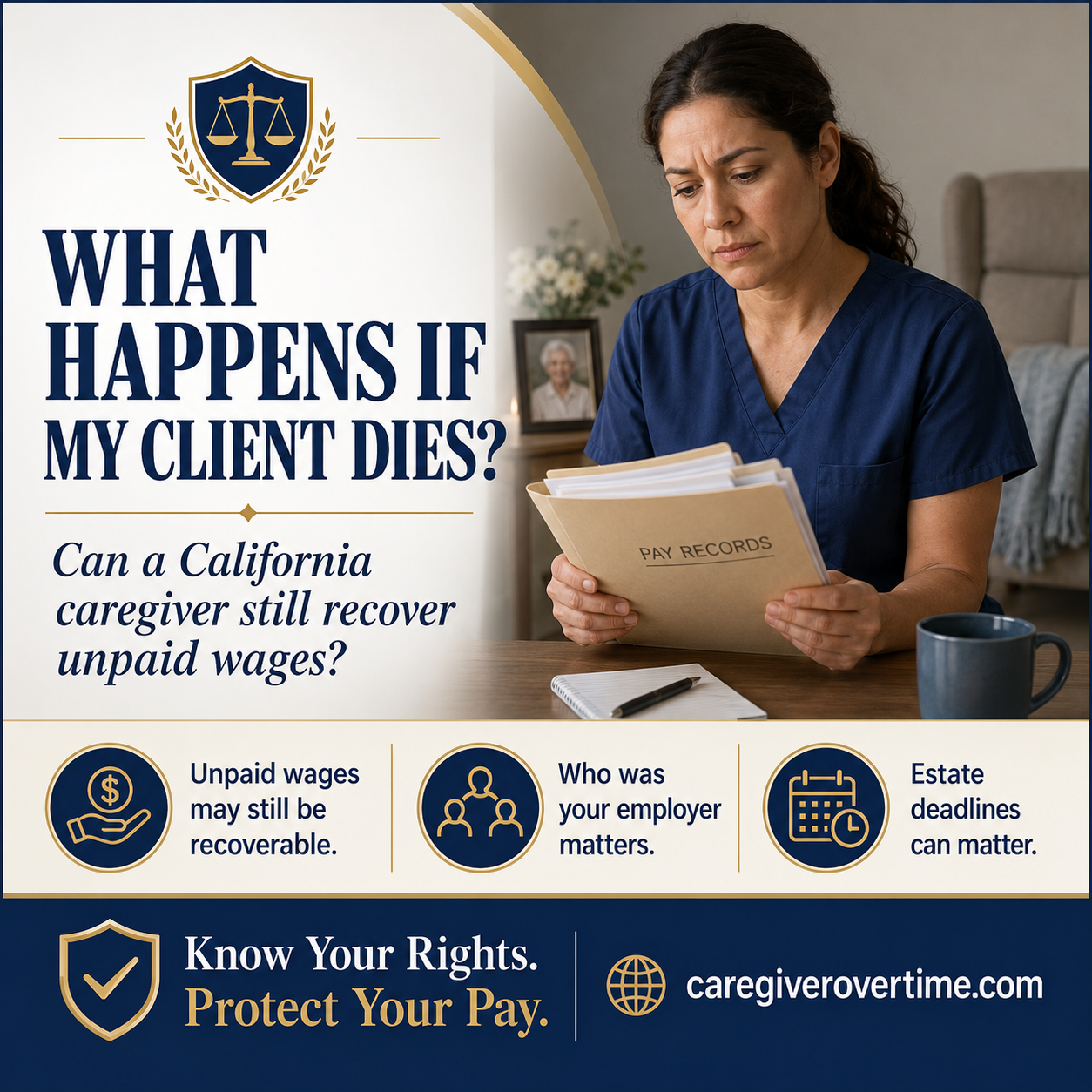
What Happens If My Client Dies? Can a California Caregiver Still Recover Unpaid Wages?
Your client dies.
You are grieving someone you may have cared for every day for months or even years.
Then another realization hits you:
You still haven't been paid everything you are owed.
Maybe your final paycheck never arrived.
Maybe you regularly worked 12-hour shifts but were only paid for 8 or 9 hours.
Maybe you worked overnight and were told your sleeping hours didn't count.
Maybe the family paid you a flat daily rate even though you regularly worked overtime.
And now someone tells you:
“There's nothing we can do. She died.”
That may not be true.
A client's death can change how a California caregiver pursues unpaid wages.
It does not necessarily mean the wages disappear.
California workers can pursue wage claims for unpaid wages and overtime, and when the person who owed the debt has died, California probate law provides procedures that can allow creditors to make claims against the deceased person's estate.
The first question is usually not:
“Did my client die?”
It is:
Who Was Actually Your Employer?
That answer can completely change what happens next.
Situation #1: You Worked for a Home Care Agency
Suppose a home care agency hired you.
The agency:
assigned you to the client;
set or communicated your schedule;
issued your paychecks;
maintained your payroll records; and
sent you to care for the client.
If the client dies, your employment relationship with the agency does not necessarily disappear.
The client may have been the person receiving the care, but the agency may have been your employer.
In that situation, a wage claim may still be against the agency.
The agency generally cannot avoid an existing wage obligation simply because the particular client you cared for died.
Maybe the assignment ends.
Maybe the agency offers you another client.
Maybe your employment ends entirely.
Those issues can affect future work.
But they do not automatically erase wages you already earned.
California's Labor Commissioner accepts claims from workers for unpaid wages, overtime and other compensation owed by an employer or former employer.
Situation #2: The Client Hired You Directly
This is different.
Suppose an elderly client personally hired you.
She decided your schedule.
She paid you.
You worked directly in her home.
No agency was involved.
If she dies while still owing you wages, the fact that the employer has died may mean the claim has to be addressed through her estate.
California Probate Code section 9000 broadly defines a claim against an estate to include a demand for payment arising from a liability of the deceased person, whether the liability arose through contract or otherwise.
In plain English:
A person's debts do not necessarily disappear when that person dies.
They may become debts that must be addressed during administration of the estate.
That can include a legitimate claim for compensation owed for work performed before death.
Situation #3: A Family Member Hired You
This is where things become more complicated.
Imagine you cared for an elderly woman, but her daughter:
interviewed you;
hired you;
decided your rate;
created your schedule;
texted you instructions;
approved your hours; and
paid you from her own account.
The client may have been the person receiving your care.
But the daughter may have been your employer—or may at least be relevant to determining who employed you.
Now imagine instead that the daughter handled everything only because she had authority to act for her mother's finances, and the money always came from the mother's funds.
That may present a different question.
This is why caregivers should not assume:
“My client died, therefore my employer died.”
The person receiving care and the person legally responsible for paying the caregiver are not always the same person.
Start by Asking These Questions
If your client has died and you are still owed money, write down:
Who hired you?
Who interviewed you?
Who told you what your hourly, daily or weekly rate would be?
Who created your schedule?
Who could fire you?
Who instructed you about your duties?
Who actually paid you?
Whose name appeared on checks?
Did you work through an agency?
Did a family member manage your employment?
Was the client personally handling your employment?
Was there a trust, estate, conservatorship or other arrangement involved?
Do not assume you already know who the legally responsible employer was.
That question may need to be analyzed.
“The Family Says the Estate Doesn't Owe Me Anything”
A family member does not necessarily get the final word.
If the deceased client was actually your employer and owed wages when they died, you may potentially be a creditor of the estate.
California Courts provides a formal Creditor's Claim procedure for people who are owed money or property by a deceased person.
A creditor can use California Probate Form DE-172 to assert a qualifying claim against an estate.
The form specifically instructs claimants to identify the debt, describe the service rendered or debt incurred, and state the amount claimed.
That means the issue is not necessarily resolved because a son, daughter or other relative says:
“Mom died. There's no money for you.”
There may be a legal process for determining whether the debt is valid and whether estate assets are available to pay it.
Probate Deadlines Can Be Much Shorter Than Caregivers Expect
This is one of the most important parts of this article.
A caregiver might have heard:
“You can go back three years for unpaid overtime.”
California's Labor Commissioner does state that many claims for minimum wage, overtime, unpaid meal or rest premiums, illegal deductions and unreimbursed expenses generally have a three-year filing period, while some contract claims may have different deadlines.
But when an employer dies, probate deadlines may create an additional problem.
California Probate Code section 9100 generally requires a creditor's claim to be filed by the later of:
four months after letters are first issued to a general personal representative, or
60 days after notice of administration is mailed or personally delivered to the creditor.
There can be exceptions and additional rules, but caregivers should not assume that the ordinary wage-claim limitation period is the only deadline that matters.
If the person who directly employed you dies, act promptly.
Waiting can make an otherwise valid claim much harder to pursue.
What Is the “Estate”?
Many people hear the word “estate” and think it means someone must have been extremely wealthy.
That's not what the word means in this context.
A deceased person's estate can include property and assets that are subject to administration after death.
Depending on the circumstances, that could potentially include:
money in bank accounts;
real estate;
vehicles;
investments;
personal property; and
other assets belonging to the deceased person.
A personal representative—often called an executor or administrator—may be appointed to administer the estate.
Creditors can then potentially submit claims seeking payment from estate assets.
The personal representative generally must either allow or reject properly filed creditor claims. California's 2026 Rules of Court require the personal representative to act on each creditor claim in writing and serve the creditor with the decision.
Does the Family Have to Pay Me Personally?
Not necessarily.
This is an important distinction.
A client's children do not automatically become personally responsible for every debt their parent owed merely because they inherited property or are related to the client.
If the client was the employer, the potential claim may be against the client's estate.
But that is different from a situation where a son, daughter, spouse or another person was themselves your employer or otherwise legally responsible.
For example:
Scenario A
The elderly client hires you, directs your work and pays you.
The client's daughter is simply a family member.
The client dies.
The wage claim may primarily involve the deceased client's estate.
Scenario B
The daughter personally hires you, controls your work, promises to pay you and pays you from her account.
Her mother is the person receiving care.
The mother dies.
The fact that the client died may not necessarily eliminate a potential claim against the daughter if the daughter was actually the employer.
Scenario C
A home care company employs you and sends you to the client.
The client dies.
Your wage claim may remain against the agency.
The facts matter enormously.
What If the Family Says, “We Never Agreed to Pay Overtime”?
That does not necessarily eliminate an overtime claim.
California overtime rights are generally created by law, not simply by whatever the family agreed to pay.
For example, qualifying California personal attendants generally have overtime protections after certain daily or weekly thresholds.
If you worked overtime but were paid only straight time—or were paid a daily or weekly flat amount—the death of the client does not automatically transform that underpayment into a lawful payment.
The underlying question remains:
What wages should you legally have received for the hours you worked?
Example: A Caregiver Is Owed $18,000 When Her Client Dies
Suppose Elena worked directly for an elderly client.
She worked:
12 hours per day
5 days per week
for several years.
Her employer paid her a flat amount each week.
After reviewing her hours, Elena believes she was never paid the full overtime legally required.
Then her client dies.
The family tells her:
“Her bank accounts are frozen. We can't pay you anything.”
That statement does not necessarily mean Elena loses the claim.
If the client was Elena's employer, Elena may need to determine:
whether a probate estate has been opened;
who was appointed personal representative;
whether she received a notice of administration;
what deadline applies to a creditor claim;
what amount of wages and overtime she can document; and
whether another person or entity may also bear responsibility.
This is a very different situation from simply sending another demand for a paycheck.
It requires attention to both employment law and probate procedure.
What If No Probate Case Has Been Opened?
Do not assume that means you have no rights.
Not every death immediately results in a formal probate proceeding.
Some property may pass outside probate.
Some estates may qualify for simplified procedures.
Families may delay opening probate.
Or there may be little information available immediately after death.
That makes the situation more complicated—not necessarily hopeless.
A California attorney may need to determine:
whether probate has been opened;
whether a trust is involved;
whether someone is acting as personal representative;
whether estate assets exist;
whether another person or company was actually the employer; and
what procedure is available to preserve the wage claim.
The key is not to simply wait indefinitely.
What If the Estate Rejects My Claim?
A rejected creditor claim does not necessarily mean the dispute is over.
California Probate Code section 9353 generally provides a 90-day period after notice of rejection to commence an action on a claim that is already due, subject to the statute's specific requirements.
That is another reason the probate process can move much faster than a caregiver expects.
A caregiver who receives a formal rejection should not put the letter aside for several months.
The deadline may be running.
Can Filing a Creditor Claim Affect the Statute of Limitations?
Potentially.
California Probate Code section 9352 states that filing a creditor claim—or a qualifying petition for permission to file a late claim—can toll an otherwise applicable statute of limitations until the claim is allowed, approved or rejected.
This is technical territory, however.
Caregivers should not attempt to calculate deadlines by guessing.
Probate and wage statutes can interact in ways that are not obvious.
“The Client Died Before My Last Paycheck”
Even when there is no long-running wage dispute, a caregiver may simply be owed the final few days or weeks of regular wages.
For example:
You normally get paid every Friday.
Your client dies on Tuesday.
You worked:
Saturday — 12 hours
Sunday — 12 hours
Monday — 10 hours
Tuesday — 4 hours
Those hours were still worked.
The death of the client does not mean the labor became free.
The remaining wages still need to be accounted for.
Depending on who employed you and how the employment relationship ended, California's final-pay rules may also become relevant.
California imposes specific rules governing when final wages must be paid when an employee quits or is discharged, and waiting-time penalties can potentially apply to certain willful failures to timely pay final wages.
Whether those provisions apply in the unusual circumstance of a direct household employer's death can depend on the facts, so caregivers should not assume either that penalties automatically apply or that they automatically do not.
What If I Was Paid Cash?
Cash payment does not automatically eliminate your wage rights.
Many private caregivers are paid:
cash;
personal checks;
Zelle;
Venmo;
another electronic payment service; or
a combination of methods.
The important question is whether an employment relationship existed and whether legally required wages were paid.
If the employer has died and you do not have traditional payroll records, your own evidence can become especially important.
What Records Should You Save Immediately?
After a client's death, records can disappear quickly.
The client's phone may be disconnected.
Family members may change passwords.
Electronic caregiving accounts may close.
You may lose access to the house.
The agency may remove the client from your scheduling app.
The family's attention naturally shifts toward funeral arrangements and estate administration.
So preserve any records you lawfully possess as soon as possible.
Useful evidence can include:
Timesheets
Save every timesheet available to you.
Work Schedules
Screenshot your normal schedule and previous assignments.
Text Messages
Save communications showing:
when you arrived;
when you left;
requests to work additional hours;
overnight duties;
schedule changes;
pay discussions; and
instructions from the client or family.
Payment Records
Preserve:
checks;
bank deposits;
Zelle or Venmo records;
payroll records;
handwritten payment notes; and
tax documents.
Calendars
A personal calendar can help reconstruct when you worked.
Caregiver Logs
Care notes can sometimes help demonstrate the times and dates services were performed, provided you lawfully possess the records and do not improperly take protected medical records.
Job Agreements
Save employment agreements, handwritten notes and texts discussing your rate of pay.
Evidence of Who Employed You
This becomes especially important after the client dies.
Preserve communications showing who:
hired you;
scheduled you;
supervised you;
instructed you;
negotiated your pay; and
paid you.
California's Labor Commissioner encourages workers pursuing wage claims to gather records such as schedules, time records and proof of pay. The employer also has obligations to maintain accurate payroll records, although particular recordkeeping rules can vary depending on the employment setting.
Don't Throw Away Years of Records Because the Job Is Over
A caregiver may understandably think:
“My client is gone. I'll never need these schedules again.”
That can be a serious mistake.
If you later discover that you were underpaid for several years, those schedules may become critical evidence.
Before deleting anything, preserve:
screenshots;
texts;
emails;
payroll records;
calendars;
photos of schedules;
notebooks; and
payment history.
Keep the original electronic files where possible.
What If the Family Offers Me a Small Final Payment?
Be careful before signing anything.
A family might say:
“Here's $2,000. Sign this and we'll consider everything settled.”
If you suspect you may be owed substantially more in unpaid overtime, do not assume the amount offered reflects the value of the potential claim.
A release, settlement agreement or other document can have important legal consequences.
Consider having it reviewed before signing away potential wage claims.
What If I Didn't Discover the Overtime Problem Until After the Client Died?
That can happen.
Perhaps another caregiver tells you:
“You were supposed to get overtime after nine hours.”
You start looking through old schedules.
Suddenly you realize:
You worked 12-hour shifts for three years.
You were paid the same hourly rate for every hour.
The client died two months ago.
This is exactly the type of situation where acting promptly matters.
California's Probate Code does allow limited circumstances where a court may permit a late creditor claim, including certain situations involving lack of proper notice or later discovery of facts giving rise to the claim. But those exceptions themselves contain deadlines and conditions.
Do not rely on getting an exception later.
Investigate the claim now.
What If I Worked for the Client's Husband and Wife?
Suppose you cared primarily for the wife.
The husband hired you.
Both lived in the home.
The wife dies.
Your job ends.
Who was your employer?
Possibly the husband.
Possibly the wife.
Possibly both, depending on the facts.
The death of the person receiving the majority of the care does not necessarily answer the employment question.
Look closely at:
who controlled your work;
who promised your wages;
who paid you;
who had authority to hire or fire you; and
whose benefit the employment arrangement served.
This is another situation where the phrase “my client died” may hide a much more complicated legal relationship.
What If the Person Who Died Was NOT My Employer?
This distinction can simplify the situation considerably.
For example:
You work for ABC Home Care Agency.
ABC assigned you to Mrs. Smith.
Mrs. Smith dies.
ABC still owes you:
last week's regular wages;
overtime from prior months; and
potentially other compensation.
The client's death does not necessarily affect ABC's existing wage obligations.
In that situation, you may not be pursuing the deceased client's estate at all.
You may simply have a wage claim against the agency.
Frequently Asked Questions
If my caregiving client dies, do I lose my unpaid wages?
Not necessarily. Wages already earned do not simply vanish because the person receiving care died. Who owes the money and how the claim must be pursued depends heavily on who actually employed you.
Can I file a claim against my client's estate?
Potentially, if the deceased client was your employer and owed you compensation. California probate law allows creditors to present certain debts and liabilities against a deceased person's estate.
How long do I have to make a claim against a California estate?
Probate Code section 9100 generally requires a creditor to file by the later of four months after letters are first issued to a general personal representative or 60 days after notice of administration is mailed or personally delivered. Other statutes and exceptions may also affect the deadline.
What if I worked for an agency?
If the agency was your employer, the client's death may not change your ability to pursue unpaid wages from the agency.
Are the client's children responsible for my unpaid overtime?
Not automatically simply because they are the client's children. But a family member could potentially have separate responsibility if they were themselves an employer or otherwise legally responsible. The specific employment relationship needs to be examined.
What if the estate says there is no money?
Having a valid claim and being able to collect it are separate issues. The Labor Commissioner similarly warns workers that identifying responsible parties and available assets can be important to actually recovering unpaid wages.
What happens if my creditor claim is rejected?
California Probate Code section 9353 generally provides a limited period—often 90 days after notice of rejection for a claim already due—to commence an action on a rejected claim. Seek advice quickly if you receive a rejection.
Can I recover wages if I was paid cash?
Potentially, yes. Payment in cash does not automatically eliminate wage protections. Other records and evidence may help establish your hours and rate of pay.
What if I don't have timesheets?
Other evidence may include schedules, texts, emails, calendars, payment records, witnesses and your own records. The Labor Commissioner specifically encourages workers to provide available documentation when pursuing unpaid wages.
Should I wait until the family finishes grieving before asking about my wages?
Compassion and sensitivity are understandable, especially when you had a close relationship with the client.
But legal deadlines do not necessarily pause because the circumstances are emotionally difficult.
You can be respectful while still protecting your rights.
If significant wages may be owed, find out what deadlines apply promptly.
You Can Grieve Your Client and Still Protect the Wages You Earned
Caregiving is different from many jobs.
You may have:
helped your client bathe;
cooked their meals;
accompanied them to doctors;
stayed awake with them during difficult nights;
held their hand;
talked with their family;
watched their health decline; and
spent more waking hours with them than many relatives did.
When that person dies, immediately thinking about money can feel uncomfortable.
But asking to be paid for work you already performed is not disrespectful.
You earned those wages before the client died.
The important thing is to identify who legally employed you and act before important evidence or deadlines disappear.
Did Your Client Die While You Were Still Owed Wages or Overtime?
If you are a California caregiver whose client recently died, do not automatically accept statements such as:
“The debt died with them.”
“There's no employer anymore.”
“The estate doesn't pay caregivers.”
“The family isn't responsible.”
Any one of those statements may oversimplify the actual legal situation.
Instead, determine:
Who actually employed you?
How many hours did you work?
How much were you paid?
Was overtime properly calculated?
Is a home care agency potentially responsible?
Was another family member your employer?
Has a probate estate been opened?
Is there a deadline to submit a creditor claim?
What records can you preserve right now?
CaregiverOvertime.com can help California caregivers examine these questions and determine whether unpaid wages may still be recoverable after a client's death.
If you spent months or years caring for someone and believe you were not paid everything California law required, the client's death does not necessarily mean the wage claim is gone.
But the deadlines can change quickly.
Contact us promptly to have your employment arrangement and wage records reviewed.
This article provides general information about California employment and probate law and is not legal advice. Claims involving a deceased employer can involve unusually short filing deadlines. The correct procedure depends on who employed the caregiver, whether an estate has been opened, the type of wage claim, and other facts.