

Who Is Responsible for Paying a Caregiver? The Family, Agency, or Both?
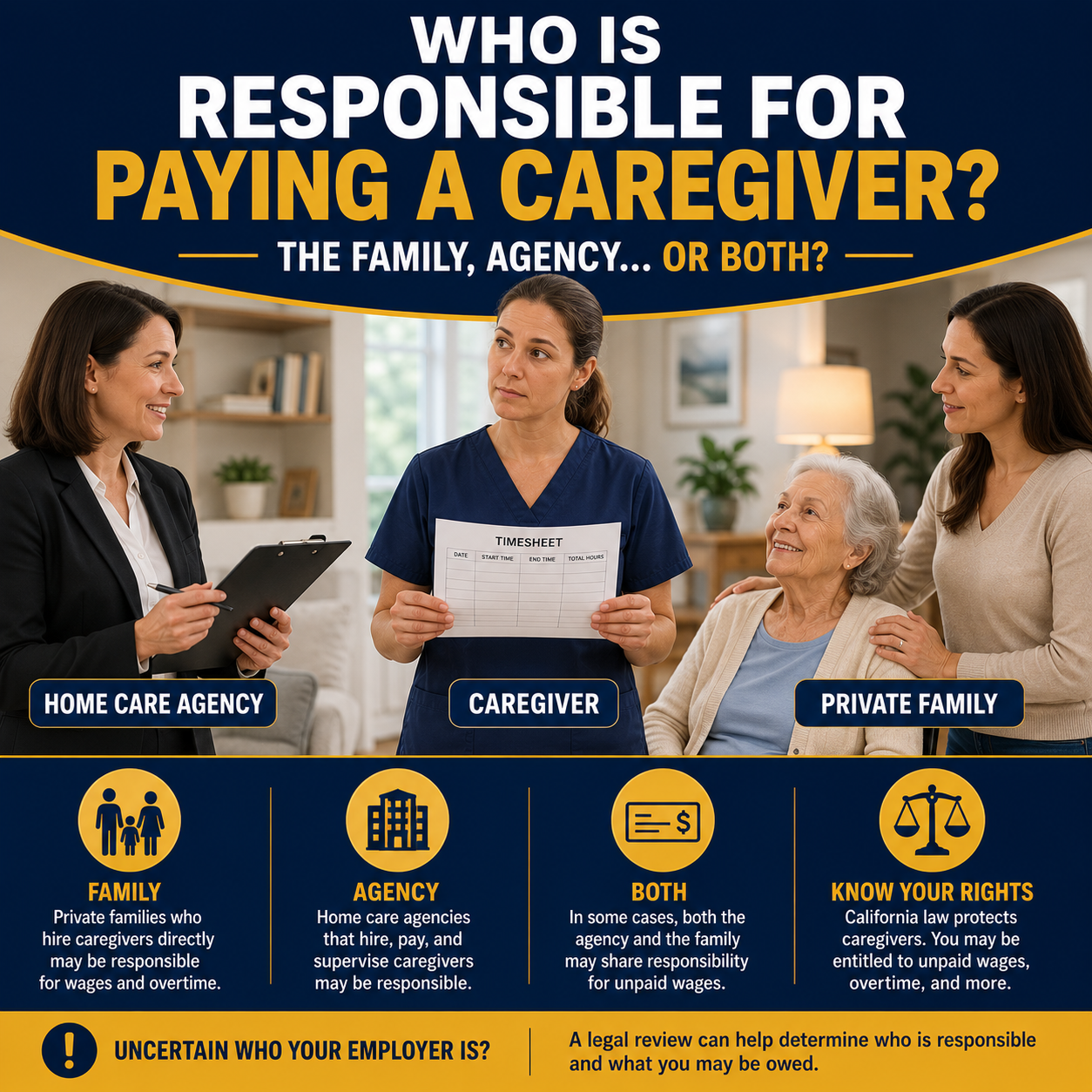
One of the most common questions caregivers ask is:
"Who is actually responsible for paying me correctly?"
Sometimes the answer seems obvious.
Other times, it's surprisingly complicated.
Perhaps you:
Were hired through a home care agency.
Work directly for a private family.
Receive paychecks from one company but take instructions from another.
Care for several clients each week.
Live in your client's home.
When overtime goes unpaid or wage violations occur, caregivers often wonder:
Should I contact the family?
Is the agency responsible?
Can both be responsible?
What if I don't even know who my employer is?
Understanding who may be legally responsible is an important first step in protecting your rights under California labor law.
Why This Question Matters
Before unpaid wages can be recovered, it's important to determine:
Who employed the caregiver?
The answer affects:
Wage responsibility
Overtime obligations
Payroll requirements
Recordkeeping duties
Potential liability
Fortunately, California law looks beyond job titles and paperwork to determine who exercised control over the employment relationship.
Caregivers Are Employed in Several Different Ways
1. Directly by a Private Family
Many caregivers are hired directly by:
Adult children
Spouses
Parents
Family members caring for elderly relatives
These arrangements are often informal.
There may be:
No written contract
No employee handbook
No payroll department
No timekeeping system
Even so, a private family may still be considered the employer under California law.
2. Through a Home Care Agency
Some caregivers work for licensed home care agencies.
Typically, the agency:
Hires the caregiver
Sets pay rates
Issues paychecks
Creates schedules
Maintains employment records
In these situations, the agency often has significant employment responsibilities.
3. Shared Arrangements
Sometimes the relationship is more complicated.
For example:
A home care agency hires the caregiver.
The client's family:
Controls the schedule.
Assigns daily duties.
Approves overtime.
Directs the caregiver's work.
Situations like these can create questions about who exercised sufficient control over the employment relationship.
California Looks Beyond Job Titles
Many caregivers believe:
"My paycheck came from the agency."
or
"The family paid me cash."
But those facts alone do not always determine who may have legal responsibilities.
California courts often examine the actual working relationship.
Questions may include:
Who hired you?
Who supervised your work?
Who determined your schedule?
Who could fire you?
Who controlled your daily responsibilities?
Who decided your pay?
The answers help determine who functioned as your employer.
When a Private Family May Be Responsible
A family may potentially be responsible when they:
Hire you directly.
Set your work schedule.
Control your daily activities.
Pay you.
Supervise your caregiving duties.
This commonly occurs in private home care arrangements.
When an Agency May Be Responsible
A home care agency may have employment responsibilities if it:
Recruited you.
Hired you.
Issued your paychecks.
Determined your pay.
Scheduled your assignments.
Maintained payroll records.
Many agencies also have legal obligations regarding:
Overtime
Minimum wage
Wage statements
Timekeeping
Can Both the Family and Agency Be Responsible?
In some situations, multiple parties may share legal responsibility.
This often surprises caregivers.
For example:
An agency hires the caregiver.
The family:
Directs daily care.
Requires overnight work.
Extends shifts.
Controls the caregiver's schedule.
Depending on the specific facts, both relationships may become important when evaluating wage claims.
Every case is different, and determining legal responsibility requires a careful review of the employment arrangement.
Common Situations That Cause Confusion
You Were Paid by the Family
You may have been:
Paid in cash
Paid through Zelle
Paid by personal check
This does not necessarily make the arrangement illegal.
However, wage laws may still apply.
You Received Paychecks From an Agency
Even if an agency issued your paycheck, another party may have exercised significant control over your day-to-day work.
Understanding who directed your employment is an important part of evaluating a wage claim.
Multiple Family Members Directed Your Work
Many caregivers receive instructions from:
Several siblings
Adult children
Guardians
Trustees
When multiple people participate in supervising the caregiver, determining legal responsibility may require a closer analysis.
Common Wage Violations Regardless of Who Pays
Whether your employer is a family, an agency, or another entity, caregivers frequently experience:
Flat daily rates
Unpaid overtime
Overnight shifts without additional compensation
Missing meal periods
Missing rest breaks
No pay stubs
No time records
Cash payments
California labor laws generally apply regardless of whether the employer is large or small.
What If You Were Paid "Off the Books"?
Many caregivers worry:
"I was paid cash."
Being paid off the books does not automatically eliminate your rights.
Even without:
Payroll records
Tax forms
Written contracts
California labor protections may still apply.
Immigration Status Does Not Change Wage Rights
Many caregivers fear:
Reporting wage violations
Asking about overtime
Contacting an attorney
California law generally protects workers regardless of immigration status.
Employers cannot legally avoid paying earned wages simply because a caregiver is undocumented.
What Evidence Can Help Identify Your Employer?
Helpful evidence may include:
Offer letters
Text messages
Emails
Schedules
Pay records
Bank deposits
Agency paperwork
Care plans
Instructions from family members
Even informal communications can help clarify who directed your employment.
Frequently Asked Questions
I was hired by an agency but worked inside a private home. Who was my employer?
The answer depends on the facts. Courts often examine who controlled your work, your schedule, and your pay rather than relying on labels alone.
The family paid me directly in cash. Do California wage laws still apply?
Often, yes. Private households that hire caregivers may still have responsibilities under California labor law.
Can more than one party be responsible?
In some situations, multiple parties may share responsibility depending on how the employment relationship operated.
What if I never signed an employment agreement?
A written agreement is not required to establish an employment relationship.
Final Takeaway
Many caregivers assume it is obvious who their employer is.
In reality, caregiving arrangements often involve private families, home care agencies, and multiple individuals directing the caregiver's work.
Determining who is legally responsible for unpaid wages is one of the most important parts of evaluating a caregiver wage claim.
If you worked long hours, received a flat daily rate, or believe you were denied overtime, do not assume you know who may be legally responsible.
California labor law examines the actual working relationship—not simply who signed the paycheck.
Understanding who controlled your employment can be the key to recovering unpaid wages and protecting your rights.
If you are unsure who your employer was, a careful review of your work arrangement may help answer that question and determine whether you have a claim.