

What Happens If My Employer Never Kept Track of My Hours? A California Caregiver's Guide
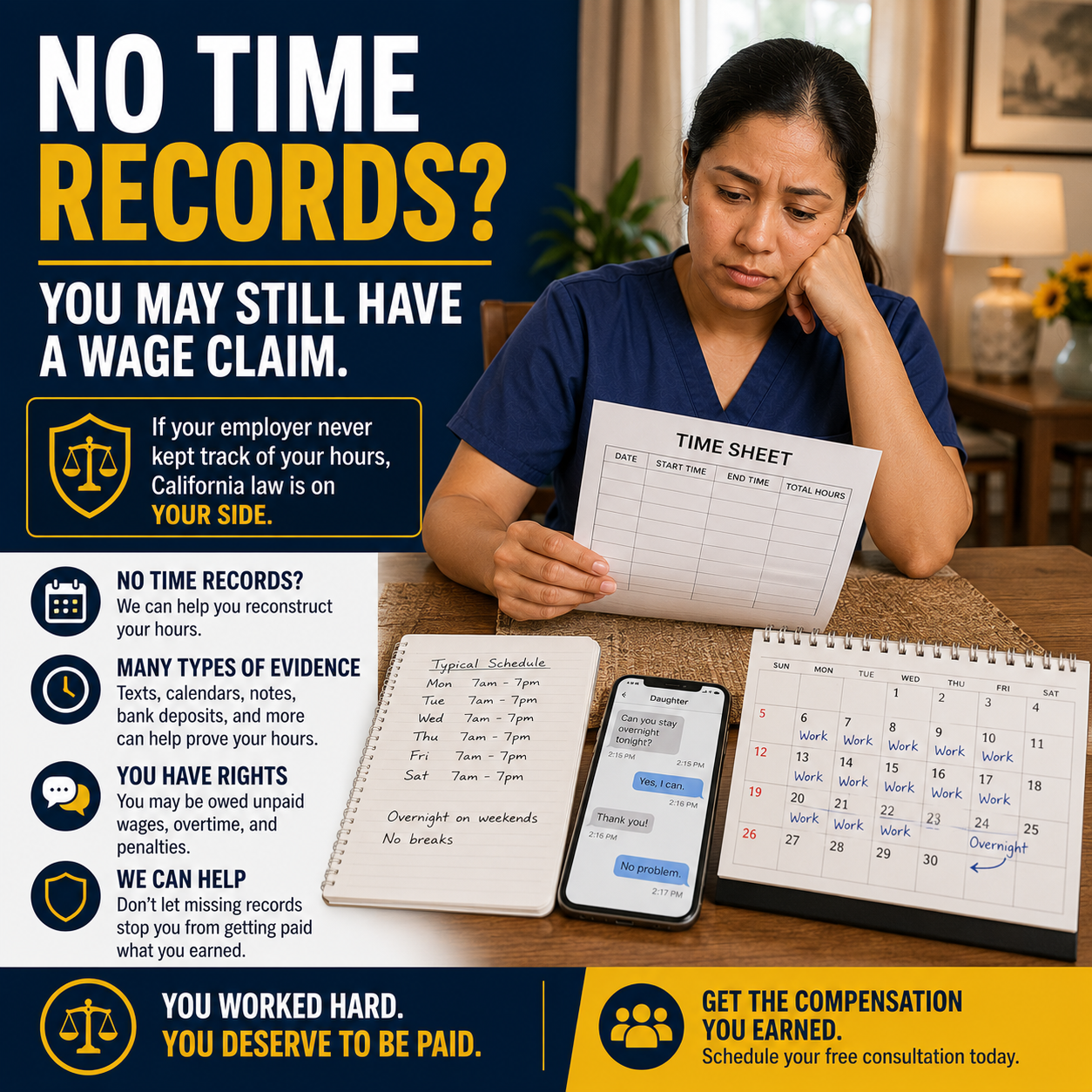
One of the biggest reasons caregivers hesitate to pursue unpaid wage claims is because they believe they cannot prove how many hours they worked.
Many caregivers tell us:
"I never clocked in."
"The family never kept timesheets."
"I was paid cash every week."
"There are no payroll records."
"It's just my word against theirs."
Fortunately, California law recognizes that employers—not employees—are generally responsible for maintaining accurate payroll and timekeeping records.
If your employer failed to keep those records, you may still have a strong wage claim.
California Employers Generally Have a Duty to Keep Time Records
Under California law, employers are generally required to maintain accurate records of:
Hours worked
Start times
End times
Meal periods
Wages paid
Pay periods
These records are important because they ensure employees receive:
Minimum wage
Overtime pay
Meal and rest break premiums
Accurate wage statements
Unfortunately, many caregivers—especially those working in private homes—never receive these protections.
This Problem Is Extremely Common in Caregiving
Many caregiving jobs begin informally.
For example:
A daughter hires someone to care for her elderly mother.
She says:
"We'll just pay you every Friday."
No paperwork.
No employee handbook.
No payroll system.
No timesheets.
No pay stubs.
Months—or even years—later, the caregiver realizes they were working:
Twelve-hour shifts
Overnight care
Weekends
Holidays
without receiving overtime.
This situation is far more common than many people realize.
Does the Lack of Time Records Mean You Cannot Recover Wages?
No.
The absence of employer records does not automatically prevent a caregiver from recovering unpaid wages.
In many wage cases, courts recognize that employees should not be penalized because an employer failed to keep legally required records.
Instead, caregivers may be able to establish their work schedules using other forms of evidence.
Evidence That Can Help Reconstruct Your Hours
Many caregivers are surprised by how much documentation they already have.
Examples include:
Text Messages
Messages discussing:
Start times
Shift changes
Overnight coverage
Schedule requests
Days off
can help establish your work schedule.
Calendars
Many caregivers keep calendars showing:
Days worked
Medical appointments
Vacation requests
Patient routines
Even handwritten calendars may become useful evidence.
Phone Records
Location history, GPS records, or call logs may help demonstrate:
Arrival times
Departure times
Overnight stays
Bank Deposits
If you were paid through:
Zelle
Venmo
Cash App
Direct deposit
payment history may help establish the length of your employment.
Care Logs
Many caregivers keep notes regarding:
Medications
Meals
Blood pressure
Daily observations
Overnight interruptions
These records often help reconstruct working hours.
Photographs
Pictures taken while caring for a client sometimes include:
Time stamps
Dates
Locations
These may support your timeline.
Witnesses
Neighbors...
Family members...
Other caregivers...
Medical providers...
Even delivery drivers may remember seeing you regularly at the home.
Your Own Testimony Matters
Many caregivers believe:
"It's only my memory."
Your own testimony can be important evidence.
If you consistently describe:
Your typical schedule
Your daily routine
Overnight responsibilities
Breaks (or lack of breaks)
that information may help establish your hours worked.
Consistency is often more important than perfect precision.
Common Schedule Patterns
Many caregivers have highly predictable schedules.
Examples include:
Monday through Saturday
7:00 AM – 7:00 PM
or
Five 24-hour shifts each week
or
Live-in caregiver for six months
When schedules remain consistent, estimating hours may be much easier than caregivers expect.
Why Employers Sometimes Fail to Keep Records
Some employers simply do not understand California wage laws.
Others intentionally avoid documentation because they believe it reduces liability.
Examples include:
Paying cash
No pay stubs
No timesheets
No written agreements
Flat daily rates
Ironically, these practices often create greater legal risk for the employer—not the caregiver.
Common Misconceptions
"I Was Paid Cash."
Cash payments do not eliminate your wage rights.
"There Was No Contract."
Written contracts are not required to establish an employment relationship.
"The Family Didn't Keep Records."
That responsibility generally belongs to the employer.
"I Don't Remember Every Hour."
You do not necessarily need perfect records to establish your work schedule.
Why Documentation Still Matters
Although caregivers may still pursue claims without employer records, it is always helpful to preserve any information you have.
Starting today, consider keeping:
Daily schedules
Hours worked
Overnight interruptions
Waiting time
Meal periods
Payment records
Even simple handwritten notes may become valuable later.
How Missing Records Can Affect Overtime Claims
Accurate hours are especially important because they determine whether overtime laws apply.
Many caregivers work:
Twelve-hour shifts
Sixteen-hour shifts
Twenty-four-hour shifts
without realizing those hours may trigger overtime requirements under California law.
Reconstructing those schedules can significantly affect the value of a wage claim.
Frequently Asked Questions
Can I recover unpaid wages if my employer never kept timecards?
Possibly. Many caregivers successfully establish their work schedules using calendars, text messages, payment history, and testimony.
What if I was paid entirely in cash?
Cash payments do not automatically prevent you from recovering unpaid wages.
What if I no longer work there?
Former caregivers may still be able to pursue wage claims depending on the circumstances and applicable deadlines.
What if I only remember my typical schedule?
A consistent routine may help reconstruct your hours, especially if supported by other evidence.
Final Takeaway
Many California caregivers assume they cannot pursue unpaid wages because their employer failed to keep time records.
In reality, California law generally places the responsibility for accurate payroll and timekeeping on the employer—not the caregiver.
If you worked long hours caring for someone but never received proper timecards, pay stubs, or payroll records, you should not assume you have no case.
Your schedules, text messages, payment history, care logs, calendars, and even your own testimony may help establish the hours you worked.
If you believe you were underpaid, understanding your rights is the first step toward determining whether you may be entitled to recover unpaid wages, overtime, and other compensation under California law. Contact Us For A FREE Consultation