

Frequently Asked Questions About California Caregiver Overtime and Wage Rights
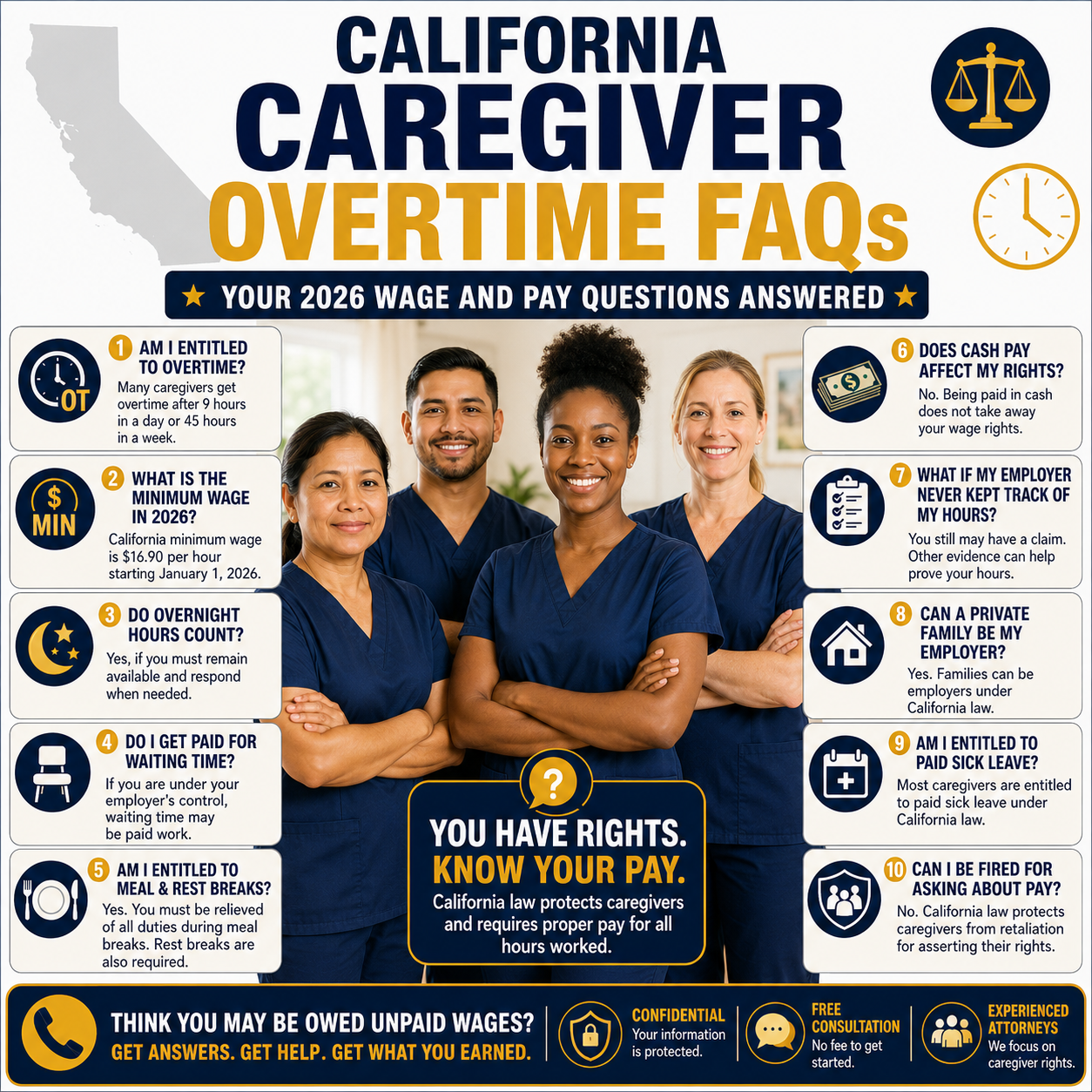
California caregivers perform essential work for elderly adults, people with disabilities and families who need reliable in-home support.
Despite the importance of their work, many caregivers are unsure whether they are being paid correctly.
Common questions include:
When does caregiver overtime begin?
Does overnight time count as work?
Can a caregiver legally receive a flat daily rate?
Does being paid in cash affect wage rights?
Can a private family be an employer?
What happens when no time records exist?
The answers depend on the caregiver’s duties, work arrangement and classification. This guide addresses the most common questions caregivers ask about California wage and hour protections.
This article provides general information and is not a substitute for legal advice about a specific employment situation.
Quick Answer: When Do California Caregivers Receive Overtime?
A California domestic worker classified as a personal attendant is generally entitled to overtime at one and one-half times the regular rate for hours worked beyond nine in one workday or 45 in one workweek. Different rules may apply when a caregiver performs a significant amount of non-attendant work, works through certain programs or agencies, or falls under another wage order or exemption.
Because classification matters, caregivers should not assume that every home-care position follows exactly the same overtime formula.
California Caregiver Overtime FAQs
1. Are caregivers entitled to overtime in California?
Many are.
Personal attendants covered by California’s Domestic Worker Bill of Rights generally receive overtime at one and one-half times their regular rate after:
Nine hours in one workday
Forty-five hours in one workweek
The rule applies to covered personal attendants employed by private households and qualifying third-party employers.
Caregivers who perform substantial housekeeping, cleaning, cooking or other work beyond personal-attendant duties may fall under different wage and overtime rules. The employee’s actual duties matter more than the job title.
2. What is a “personal attendant”?
California’s wage order defines a personal attendant as someone employed by a private householder or qualifying third-party employer to supervise, feed or dress a person who needs assistance because of age, disability or mental deficiency.
Personal-attendant status generally applies when the worker does not spend a significant amount of time performing duties beyond supervision, feeding and dressing.
Examples of duties commonly associated with personal attendance include:
Assisting with dressing
Helping with meals
Providing supervision
Offering companionship
Assisting with basic personal needs
A caregiver who also performs extensive housecleaning, laundry, cooking for an entire household or other non-care duties may require a different legal analysis.
3. Is every caregiver subject to the nine-hour and 45-hour thresholds?
No.
Those thresholds specifically apply to covered personal attendants under California’s Domestic Worker Bill of Rights. Other caregivers may be governed by different overtime standards depending on their duties, employer and work setting.
For example, a worker who performs significant non-attendant duties may not be treated as a personal attendant. Caregivers working in facilities, through certain government-funded programs or under specialized arrangements may also be subject to different rules.
This is why an overtime calculation should begin with the caregiver’s actual job duties and employment relationship.
4. What is California’s minimum wage for caregivers in 2026?
California’s statewide minimum wage is $16.90 per hour beginning January 1, 2026. Some cities, counties and industries require a higher local minimum wage.
A caregiver must generally receive the highest applicable minimum wage for the location and employment arrangement.
For example, a caregiver working in a city with a local wage above $16.90 may be entitled to that higher rate.
5. Can a caregiver be paid a flat daily rate?
A flat daily rate is not automatically unlawful, but it does not remove minimum-wage and overtime obligations.
The employer must still ensure that the caregiver receives:
At least the applicable minimum wage for every compensable hour
Proper overtime compensation
Any other legally required premiums or wages
A caregiver who receives $200 for an eight-hour day and $200 for a 16-hour day should closely examine whether all hours and overtime were properly compensated.
An agreement to accept a daily rate generally does not waive statutory wage protections.
6. Can caregivers legally be paid a salary?
A caregiver may receive a salary as a method of payment, but receiving a salary does not automatically make the caregiver exempt from overtime.
Most hands-on caregivers do not satisfy the duties requirements for California’s executive, administrative or professional exemptions. California also requires exempt employees to satisfy a minimum salary threshold, which is $70,304 annually in 2026, but meeting the salary threshold alone is not enough; the employee must also satisfy the applicable duties test.
A caregiver should be cautious when told:
“You are salaried, so you do not receive overtime.”
That statement is often incomplete or incorrect.
7. Do caregivers have to be paid for waiting time?
Waiting time may qualify as paid work when the caregiver remains under the employer’s control.
Relevant questions include:
Must the caregiver remain in the home?
Must the caregiver be ready to respond?
Can the caregiver freely leave?
Can the caregiver use the time for personal purposes?
Is the caregiver still responsible for the client’s safety?
A caregiver who sits nearby while a client naps may still be working if the caregiver must supervise the client and respond immediately when needed.
A genuinely off-duty period is different. The caregiver must generally be relieved of responsibility and free to use the time independently.
8. Do caregivers get paid while a client is sleeping?
Possibly.
The fact that a client is sleeping does not automatically make the caregiver off duty.
Time may be compensable when the caregiver must:
Remain on the premises
Monitor the client
Listen for movement or calls
Assist with bathroom trips
Prevent wandering or falls
Respond to emergencies
The level of restriction and responsibility is important. A caregiver who is free to leave and has no duty to respond is in a different position from one who must remain available beside the client.
9. Do overnight caregivers get paid while they sleep?
The answer depends on the facts.
Overnight arrangements may involve issues such as:
Whether the caregiver must remain on-site
Whether suitable sleeping accommodations are provided
How often sleep is interrupted
Whether the caregiver is truly relieved of duties
Whether a valid agreement applies
The caregiver’s classification and applicable wage order
Interrupted sleep spent assisting the client is work time. Additional overnight hours may also be compensable when the caregiver remains significantly restricted or under the employer’s control.
Employers should not simply assume that every hour labeled “sleep time” can be excluded.
10. What happens when sleep is repeatedly interrupted?
Each period spent responding to the client should be documented.
Common overnight interruptions include:
Bathroom assistance
Medication administration
Repositioning
Fall prevention
Dementia-related wandering
Medical monitoring
Emergency assistance
Frequent interruptions may undermine an employer’s claim that the caregiver received a genuine, uninterrupted off-duty sleep period.
Caregivers should record the time, duration and nature of every overnight interruption.
11. Are 24-hour caregiver shifts legal?
California law does not necessarily prohibit a caregiver from working a 24-hour shift, but the employer must correctly identify and compensate all hours worked.
A 24-hour arrangement can create complicated questions involving:
Active caregiving time
Waiting time
On-call time
Sleep periods
Meal periods
Overtime
Recordkeeping
A flat payment for the full shift does not automatically satisfy California law.
Caregivers working 24-hour shifts should keep detailed records of when they work, sleep, respond to the client and are genuinely relieved of responsibility.
12. Can a live-in caregiver be unpaid for time spent in the home?
Living in the client’s home does not mean every hour is work, but it also does not mean the employer can exclude every quiet or overnight hour.
The key distinction is often whether the caregiver is:
On duty
On call
Under the employer’s control
Completely relieved of responsibility
A caregiver may have personal time inside the home that is genuinely off duty. However, remaining in the home while continuously responsible for the client may qualify as work.
13. Are caregivers entitled to meal breaks?
Meal-period rules depend in part on the caregiver’s classification and the applicable wage order.
California’s general meal-period rule requires a 30-minute meal period when an employee works more than five hours. A valid off-duty meal period generally requires the employee to be relieved of all duties. An on-duty meal period is permitted only under limited conditions, including when the nature of the work prevents relief from all duty and a qualifying written agreement exists.
A caregiver who must continue supervising, feeding or responding to a client while eating may not be receiving a true off-duty meal period.
Because domestic-worker classifications can affect break rules, the specific arrangement should be reviewed carefully.
14. Are caregivers entitled to rest breaks?
California’s general rule requires an authorized, paid 10-minute rest period for every four hours worked or major fraction thereof, subject to the applicable wage order and classification.
A rest break should allow the worker to be relieved of work duties.
A caregiver who must remain actively responsible for a client throughout the supposed break may not have received a compliant rest period.
15. Are caregivers entitled to paid sick leave?
Most California employees who meet the eligibility requirements are entitled to paid sick leave.
State law generally requires employers to provide at least 40 hours or five days of paid sick leave annually. Local laws may provide greater benefits.
Paid sick leave may generally be used for qualifying purposes such as:
The employee’s illness or medical care
Preventive care
Caring for a qualifying family member
Certain crime-victim or court-related circumstances
Caregivers working for private households should not assume paid sick leave applies only to employees of large companies.
16. Does being paid in cash eliminate a caregiver’s rights?
No.
California wage protections generally do not disappear because payment was made through:
Cash
Zelle
Venmo
Cash App
Personal checks
The payment method does not determine whether the worker is an employee or whether overtime is due.
A caregiver paid in cash should preserve:
Payment messages
Bank-deposit records
Calendars
Text conversations
Personal payment logs
17. Can undocumented caregivers recover unpaid wages?
California labor protections generally apply regardless of immigration status.
An employer may not lawfully avoid minimum-wage or overtime obligations merely because a caregiver is undocumented.
Caregivers may also have protection against retaliation or immigration-related threats when asserting workplace rights.
A worker concerned about immigration consequences should seek confidential advice from qualified legal counsel.
18. Can a private family be a caregiver’s employer?
Yes.
A household may be an employer when family members:
Hire the caregiver
Set the schedule
Assign duties
Control the work
Pay the caregiver
Have authority to terminate the relationship
California’s domestic-worker protections expressly contemplate employment by private householders.
A family does not avoid employment obligations simply because it is not a traditional business.
19. Can both a family and a home-care agency be responsible?
Possibly.
In some arrangements, an agency handles hiring and payroll while the family controls daily duties, scheduling or extended shifts.
Determining responsibility may require examining:
Who hired the caregiver
Who set the pay rate
Who controlled the schedule
Who supervised the work
Who could discipline or fire the caregiver
Who maintained time records
The name appearing on the paycheck does not always answer every employment question.
20. What if several family members supervised the caregiver?
More than one family member may participate in the employment relationship.
For example:
One sibling hires the caregiver.
Another creates the schedule.
A third sends payment.
All three give work instructions.
The legal analysis focuses on the actual control and responsibilities exercised by each person.
Caregivers should save communications from everyone involved.
21. Can an employer call a caregiver an independent contractor?
An employer can use that label, but the label does not control the legal result.
California examines the actual relationship, including the level of control and whether the worker is operating an independent business.
A caregiver may be misclassified when the family or agency:
Sets the schedule
Determines the work location
Directs how care is provided
Requires personal performance
Controls the caregiver’s duties
California’s Labor Commissioner announced a multimillion-dollar citation in 2026 involving alleged caregiver misclassification, underscoring that classification remains an active enforcement issue.
22. What if the caregiver never signed an employment agreement?
A written agreement is not required for an employment relationship to exist.
Caregiving jobs are frequently created through:
Verbal conversations
Text messages
Family referrals
Informal scheduling arrangements
The actual work performed, payment received and control exercised may establish the relationship even without a signed contract.
23. What if the employer never tracked the caregiver’s hours?
Employers generally have recordkeeping obligations.
A caregiver should not assume there is no claim merely because no timecards exist.
Other evidence may help reconstruct the schedule, including:
Text messages
Calendars
Medication logs
Care notes
Bank records
Photos
Location history
Witnesses
A consistent description of the regular schedule
Missing employer records may make the case more complicated, but they do not automatically erase earned wages.
24. Can caregivers estimate their hours?
A reasonable estimate may be useful when the employer failed to maintain accurate records.
The estimate should be:
Honest
Consistent
Based on the caregiver’s actual routine
Supported by available evidence
For example, a caregiver may reconstruct a typical week using appointment records, payment dates, text messages and regular shift patterns.
Caregivers should avoid exaggeration. Credibility is critical.
25. What records should caregivers keep?
Caregivers should preserve:
Daily start and end times
Overnight interruption logs
Meal and rest periods
Waiting or on-call time
Schedules
Pay records
Text messages
Emails
Care logs
Employment agreements
Agency documents
Names of potential witnesses
Records should be stored somewhere the employer cannot access or erase.
26. Can caregivers recover wages if they already quit?
Possibly.
Leaving the job does not automatically erase an unpaid-wage claim.
Former caregivers may still be able to pursue:
Unpaid minimum wages
Unpaid overtime
Break premiums
Certain penalties
Interest
Legal deadlines apply, so caregivers should not delay in having the situation reviewed.
27. Can caregivers recover wages after being fired?
Possibly.
Termination does not eliminate wages already earned.
A caregiver may also have additional claims if the termination was connected to:
Asking about overtime
Reporting unpaid wages
Requesting lawful breaks
Exercising another protected workplace right
California prohibits certain forms of retaliation when workers assert wage and workplace protections.
28. Can a caregiver be fired for asking about overtime?
An employer may not lawfully retaliate against a worker for asserting protected wage rights.
Potential retaliation may include:
Termination
Reduced hours
Threats
Worse assignments
Harassment
Immigration-related intimidation
Timing can be important. A sudden termination shortly after a wage complaint may deserve careful review.
29. How much can an unpaid-wage claim be worth?
The value depends on factors such as:
The number of hours worked
The caregiver’s pay rate
The length of employment
Overtime hours
Minimum-wage shortfalls
Missed breaks
Final-pay issues
Recordkeeping violations
Retaliation
A caregiver who worked long overnight or 24-hour shifts for several years may have a substantially different claim from someone with a short period of occasional overtime.
Online calculators can provide a rough estimate, but a reliable calculation requires a fact-specific review.
30. How far back can a caregiver recover unpaid wages?
The applicable period depends on the legal claims asserted and the specific circumstances.
Some California wage claims may reach back three years, while certain related claims may allow recovery over a longer period. Other claims may have shorter deadlines.
Because each passing pay period can affect potential recovery, caregivers should seek advice promptly rather than assuming they have unlimited time.
31. Does an employer have to provide a pay stub?
California employers generally must provide itemized wage statements containing legally required information.
A caregiver who receives only cash or a check without a wage statement may be missing important information, including:
Hours worked
Pay rates
Gross wages
Deductions
Net wages
Employer information
Inaccurate or missing wage statements may create additional issues beyond unpaid overtime.
32. Can housing or meals be deducted from caregiver wages?
California allows meal or lodging credits in some domestic-worker situations, but restrictions and documentation requirements apply. Employers cannot simply assign any value they choose or use housing to avoid minimum-wage and overtime obligations.
Caregivers should request a clear written explanation of any housing or meal deduction.
33. Do caregivers receive extra pay for weekends or holidays?
California law does not generally require premium pay merely because work occurs on a weekend or holiday.
However, weekend or holiday hours may contribute to daily or weekly overtime.
An employer’s contract, policy or collective bargaining agreement may provide additional holiday pay even when state law does not independently require it.
34. Can caregivers discuss their pay with other workers?
Employees generally have important protections when discussing wages and working conditions.
A caregiver who works through an agency may be able to compare pay practices with other caregivers.
An employer should not use threats or discipline to unlawfully prevent protected wage discussions.
35. What should a caregiver do before contacting an attorney?
Prepare a basic summary that includes:
Dates of employment
Typical weekly schedule
Longest shifts worked
Overnight duties
How payment was made
Pay rate or flat daily amount
Whether overtime appeared on pay stubs
Whether breaks were provided
Whether the employer kept records
Whether retaliation occurred
Caregivers do not need perfect documentation before requesting a consultation.
A Simple California Caregiver Pay Checklist
Your pay may deserve a closer review when several of these statements apply:
I regularly worked more than nine hours in a day.
I regularly worked more than 45 hours in a week.
I was paid a flat daily or weekly amount.
I stayed overnight with the client.
My sleep was interrupted.
I had to remain available while the client rested.
I could not freely leave during unpaid time.
I did not receive itemized pay stubs.
My employer did not track my hours.
I was paid in cash.
I was called an independent contractor.
I was punished after asking about wages.
No single answer proves that a violation occurred. Taken together, however, these facts may indicate that the employment arrangement should be evaluated.
Final Takeaway
California caregiver wage law is more complicated than many families, agencies and caregivers realize.
The correct pay calculation may depend on:
The caregiver’s actual duties
Whether the worker qualifies as a personal attendant
The amount of employer control
Overnight and waiting-time responsibilities
Daily and weekly hours
The applicable state or local wage
The identity of the employer
Caregivers should not assume an arrangement is lawful simply because they agreed to it, were paid in cash or worked inside a private home.
If the paycheck did not reflect the hours and responsibilities of the job, the caregiver may be entitled to unpaid wages or other compensation.
At CaregiverOvertime.com, the attorneys at Rehwald Peterson focus on helping California caregivers understand their wage rights and determine whether they may have been underpaid. Contact Us For A Free Consultation